


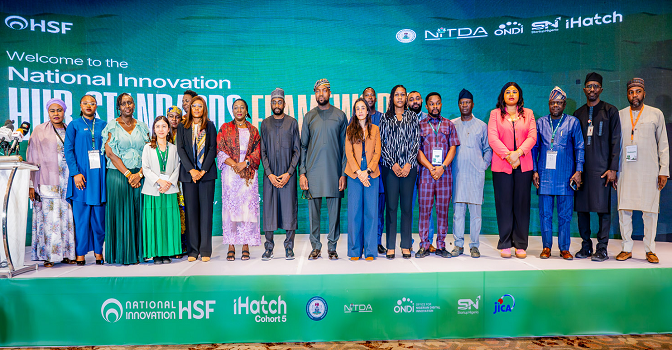
*Dr. ‘Bosun Tijani, Honourable Minister for Communications, Innovation and Digital Economy, advocates improved investment in technology hubs, innovation spaces, and ecosystem builders across Nigeria, to drive cultivating talent, and empowering entrepreneurs towards attaining a diversified, prosperous and sustainable digital economy
Gbenga Kayode | ConsumerConnect
As part of practical measures to advance the burgeoning Nigeria Digital Economy, the Federal Government has urged greater investment in technology hubs, innovation spaces, and ecosystem builders across Nigeria, identifying them as essential engines for cultivating talent, and empowering entrepreneurs in the ecosystem.
ConsumerConnect reports Dr. ‘Bosun Tijani, Honourable Minister for Communications, Innovation and Digital Economy (FMCIDE), said this while speaking at the recent National Innovation Hub Standards Framework Validation Workshop, held in Abuja, FCT.
CNII: Police nab 5 suspected vandals, recover stolen telecoms assets in Lagos
Tijani emphasised that Nigeria could not achieve a diversified and prosperous economy without directly strengthening the support systems that nurture innovation.
The Minister also noted that as high-profile tech startups often capture public attention, the underlying innovation hubs and the grassroots that make their success possible are frequently overlooked.
He further described hub managers, and physical co-working spaces as vital anchor points where young talent, creators, and entrepreneurs could collaborate, build networks, and turn original concepts into viable businesses in the digital environment.
According to Tijani, investing in these foundational hubs provides the ideal environment for young Nigerians to craft local solutions to societal challenges while creating meaningful employment opportunities across the West African country.
Minister relates personal experience in tech hub management
The Minister as well recalled his previous experience in managing a technology hub in Nigeria.
He stressed that Nigeria’s growing technology ecosystem was partly driven by the emergence of spaces that have provided entrepreneurs with access to knowledge, mentorship, networks and other forms of support.
The country’s increasing number of successful technology companies has demonstrated the enormous potential of Nigeria’s innovation ecosystem, stated he.
The Minister, however, warned that this potential could not be fully realised without stronger support structures for ecosystem builders.
Government investing in fibre optics, telecoms connectivity, satellite tech
Tijani also emphasised that Federal Government’s investment in digital infrastructure must be matched with adequate investment in the people and institutions capable of transforming such infrastructure into economic opportunities in the country.
He equally shed more light on Federal Government’s ongoing efforts at expanding digital infrastructure through investments in fibre-optic connectivity, telecommunications infrastructure and satellite technology to extend digital access to underserved and hard-to-reach communities.
The Minister disclosed the government has also strengthened other components of the digital ecosystem, including digital identity (ID) and cloud infrastructure, through new policies and strategic interventions.
Tijani, nonetheless, maintained that infrastructure alone would not deliver the desired economic transformation, if innovation hubs across the country yet lack the resources and capacity required to attract and retain skilled personnel.
He averred: “Imagine if we had all the hubs in Nigeria at the same level of quality as the best hubs in the country.
“There would be more technology businesses, more innovation and better opportunities across the country.”
The government further advocated greater documentation and transfer of knowledge from successful innovation ecosystems around the world to Nigerian technology hub managers.
According to the Minister, lessons from global best practices can help to strengthen local innovation communities.
The impact of successful technology hubs extends beyond individual entrepreneurs, as startups supported by such ecosystems could create jobs, establish new businesses, generate tax revenue and contribute to national economic growth, he stated.
Tijani further said Nigeria could not achieve sustainable economic development by relying solely on oil and gas.
He, therefore, emphasised the need for a diversified economy, driven by technology, innovation and entrepreneurship.
The Minister even cited leading Nigerian tech companies, including Paystack, as examples of what could emerge when the right innovation ecosystem, talent and support structures are available.
IT regulator designs National Innovation Hub Standards Framework: Official
In achieving this objective, therefore, the National Information Technology Development Agency (NITDA) has revealed how it is taking steps to establish common standards for innovation hubs across the country.
The agency described the move as part of efforts at decentralising Nigeria’s innovation ecosystem, and creating greater opportunities for young Nigerians to develop and scale technology-driven businesses within their local communities.
Expatiating further in this, Malam Kashifu Inuwa Abdullahi, CCIE, Director-General of NITDA, said the proposed National Innovation Hub Standards Framework is designed to provide hubs with a structured pathway for assessing their capabilities, identifying gaps, and progressing towards maturity, rather than imposing rigid requirements on operators.
Key pillars of functional innovation ecosystem, by Inuwa
Inuwa explained that innovation hubs had become critical platforms for bringing together innovators, students, entrepreneurs, investors, businesses, academia and government to exchange ideas, develop solutions and transform concepts into commercially viable enterprises.
The NITDA Chief Executive stated: “Innovation does not happen in isolation; it happens in an ecosystem. And that ecosystem does not happen by accident; it happens by design.”
He also affirmed that Nigeria has an abundance of talented and entrepreneurial young people.
The Director-General said most of such young talent yet lacked access to funding, networks, mentorship, infrastructure, and other support systems needed to translate their ideas into sustainable businesses.
Inuwa identified talent, risk capital, large corporate organisations and government as key pillars of a functional innovation ecosystem.
He also stressed that stronger collaboration among stakeholders is necessary to build sustainable Nigeria Digital Economy.
Study identified over 339 innovation hubs across Nigeria: NITDA
Inuwa expressed concern that innovation activities remained concentrated largely in Lagos, Abuja, and a few other states, despite the talent and innovation potential spread across the entire country.
The Chief Executive of the IT sector regulatory agency said the proposed innovation hub standard framework would help to develop innovation ecosystems around the unique strengths, challenges and economic opportunities of individual communities rather than attempting to replicate one model across Nigeria.
NITDA’s research has identified over 339 innovation hubs across Nigeria, although a significant proportion were concentrated in Lagos, Abuja and about 10 other states.
He explained that some hubs outside the major innovation centres are still operating primarily as training centres and required additional support to transition into full-fledged innovation, incubation and entrepreneurship centres.
Inuwa said the proposed framework contained seven key dimensions, and about 35 assessment categories through which hubs could evaluate their capabilities, identify weaknesses and determine their level of development.
He, however, cautioned that the framework is not intended to be “prescriptive” in nature but to serve as a “guide” for hubs seeking to improve their operations, services and institutional capacity.
Inuwa said the ultimate objective was to create a digital environment where young Nigerians could brainstorm, develop and test ideas, access relevant facilities, connect with businesses and investors, understand government policies and obtain the support required to build sustainable enterprises.
The Director-General emphasised the importance of private-sector participation in providing risk capital.
According to him, government alone could not sustainably finance the growth of startups and emerging businesses.
Inuwa, therefore, advocated stronger collaboration between Universities and industry.
The Director-General of the agency said higher institutions must become active participants in the innovation ecosystem by strengthening research, entrepreneurship, digital skills and industry partnerships.
He disclosed that NITDA was already working with the Federal Ministry of Education to integrate digital skills into formal education, with the aim of producing graduates equipped to participate meaningfully in the digital economy.
Inuwa described the innovation hub standards framework as a draft, urging hub founders, investors, development partners, government institutions, academia and other stakeholders to contribute their expertise towards its refinement.
Inuwa restated that a robust national network of innovation hubs would enable communities to harness local talent, develop solutions to local challenges and contribute to national economic growth.
The initiative also wi reduce the pressure on innovators to relocate to major cities before accessing the ecosystem required to develop and scale their ideas, added the Chief Executive of NITDA.
Caption……….
Malam Kashifu Inuwa Abdullahi, Director-General of NITDA, with Dr. ‘Bosun Tijani, Honourable Minister for Communications, Innovation and Digital Economy, and Other Stakeholders at the Draft National Innovation Hub Standard Framework Validation Workshop, in Abuja, FCT