


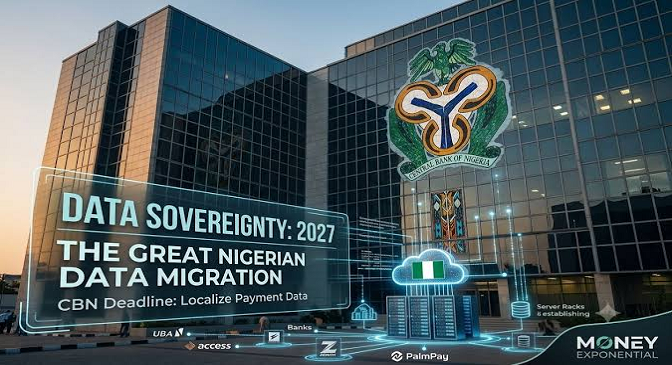
*The Central Bank of Nigeria cautions GTBank Plc, UBA Plc, Access Bank, other banks, and other regulated financial institutions are expected to ensure that ‘critical payment transaction data’ is stored and managed within the West African country in accordance with applicable regulatory requirements, emphasising the January 1, 2027, implementation timeline remains intact
Gbenga Kayode | ConsumerConnect
The Central Bank of Nigeria (CBN) has restated that its monetary policy decision on earlier noted January 1, 2027 implementation deadline for banks, Other Financial Institutions (OFIs) to localise critical customers’ payment transaction data remains sacrosanct.
ConsumerConnect reports the CBN’s insistence is said to be in accordance with Nigeria’s push for “data sovereignty”, and applicable regulatory requirements for localisation of bank customers’ transaction data within the West African country’s digital ecosystem effective from next January.
Nigerian pharmacists warn consumers against counterfeit drugs, highlight risks to public health
Lamido Abubakar Yuguda, Deputy Governor, Financial System Stability at CBN, said this at the recent CBN-National Information Technology Development Agency (NITDA) Executive Regulatory Dialogue on the National Sovereign Cloud Initiative (NSCI) and data localisation, in Lagos.
The CBN top top official again, warned banks and OFIs, that any deliberate attempts to frustrate compliance with the stated data localisation policy would attract requisite sanctions by the industry regulator.
He also noted: “Regulated institutions are expected to ensure that critical payment transaction data is stored and managed within Nigeria in accordance with applicable regulatory requirements and the January 1, 2027 implementation timeline.
Core objectives of localisation of payment transaction data
The Bankers’ Bank has said the overarching objective of the monetary policy initiative is to enhance regulatory visibility, strengthen resilience, and safeguard critical financial data in the essential Nigerian banking industry.
Yuguda explained that the policy also was aimed at strengthening financial system stability, improving regulatory oversight.
It is equally noted that the move has become consequential in view of the country’s need to safeguard critical financial data amid the growing dependence on digital/online banking, Financial Technology (FinTech), and electronic payment services in the financial space.
The Deputy Governor, Financial System Stability of the Bank said the resilience of Nigeria’s financial system increasingly depended on the security and reliability of the digital infrastructure supporting its operations.
As cloud computing offers financial institutions opportunities for greater efficiency, flexibility and innovation, he expressed concerns that the new technology also raises concerns about cybersecurity, data protection, operational resilience and dependence on third-party technology providers.
On significance of National Sovereign Cloud Initiative
It was gathered the experts, stakeholders and participants in the recent NSCI affirmed the National Sovereign Cloud Initiative provided an opportunity to strengthen Nigeria’s digital resilience, develop domestic technological capacity, and improve protection of critical financial data.
As far as the banking sector of the is concerned, Yuguda stressed that banks and Other Financial Institutions must ensure that critical payment transaction data is stored, and managed within Nigeria in line with applicable regulatory requirements and the January 1, 2027 implementation deadline.
He, however, cautioned that data localisation alone would not guarantee security in the country’s financial space.
The Deputy Governor, Financial System Stability emphasised the need for robust cybersecurity, business continuity, disaster recovery and risk-management measures.
The CBN further clarified that banks and other regulated financial institutions would remain responsible for managing risks associated with their relationships with cloud service providers and other technology partners.
NITDA CEO: Data localisation to strengthen Nigeria’s control over digital infrastructure
Speaking at the event, Malam Kashifu Inuwa Abdullahi, CCIE, Director-General of NITDA, disclosed that a survey conducted ahead of the dialogue, in Lagos, showed that 57 percent of Nigerian financial institutions were ready to comply with the data localisation requirements by the deadline January 1 next year.
Inuwa disclosed the stakeholder engagement was organised to assess the preparedness of banks, and OFIs, to provide guidance to those yet to meet the requirements in the country.
He also explained that the NSCI was a national framework covering different sectors, with the financial sector being among those required to comply with its provisions.
The Director-General of NITDA also said the initiative was designed to strengthen Nigeria’s control over its digital infrastructure, and ensure that external disruptions did not prevent consumers from accessing essential digital services in the country.
The Nigerian Government, Inuwa revealed, would also establish a compliance timeline for Ministries, Departments and Agencies (MDAs).
According to him, the financial sector of the economy is being prioritised because of its advanced level of digitalisation in Nigeria.
The NITDA Chief said that 326 MDAs had spent over N3.8 trillion on technology between June 2023 and October 2026.
Still, some of the investments could be consolidated through cloud infrastructure to improve the delivery of government digital services to Nigerians, stated he.
Banks, OFIs face sanctions, if …. –Director
In her submissions at the forum, Dr. Rakiya Opemi Yusuf, Director of the Payment Systems Supervision Department of CBN, affirmed the dialogue was convened to address concerns and clarify expectations surrounding the directive to financial institutions.
Dr. Yusuf said the Nigerian banking regulator expected all relevant institutions to comply by January 2027.
She assured that the CBN would prioritise engagement and support for institutions facing implementation challenges in the banking and finance sector.
The CBN Director, however, warned that sanctions would apply where institutions deliberately attempted to undermine compliance.
Yusuf further stated: “Sanctions is really not the first in our mind when it comes to enforcement.
“What is really first in our mind is to ensure that everybody is hand-holding to be able to achieve compliance with the regulation.”
Besides, the CBN will assess feedback from stakeholders and consider the merits of proposals for any adjustments that might be necessary, she said.
She said the bank had strengthened its oversight of the payments ecosystem through the establishment of the Payment Systems Supervision Department in 2025.
According to her, the Payment Systems Supervision Department of the CBN will ensure appropriate supervision of the sector.
Dr. Yusuf reiterated that the localisation of payment data policy was ultimately, intended to enhance Nigeria’s sovereignty over its payment transaction data, improve regulatory visibility and reinforce financial system stability.
Pingback:2027 Elections: Tinubu’s electricity pledge must be considered in full context –APC Campaign Council - Consumer Experience Is A Top Priority
Pingback:Frazimex Engineering Managing Director to keynote Realnews 14th Anniversary lecture - Consumer Experience Is A Top Priority
Pingback:2027: Threaten election personnel, face full weight of law, INEC Chairman warns - Consumer Experience Is A Top Priority
Pingback:Security operatives rescue 3 Imams kidnapped gathering to pray for Tinubu’s re-election - Consumer Experience Is A Top Priority
Pingback:Konga activates Yakata Black Friday with brand giveaways, promo to win brand-new SUV - Consumer Experience Is A Top Priority
Pingback:Nigerian pharmacists warn consumers against counterfeit drugs, highlight risks to public health - Consumer Experience Is A Top Priority
Pingback:Economic Crisis: Rioters loot stores amid violent protests in Germany as demonstrators rock France –Report - Consumer Experience Is A Top Priority