


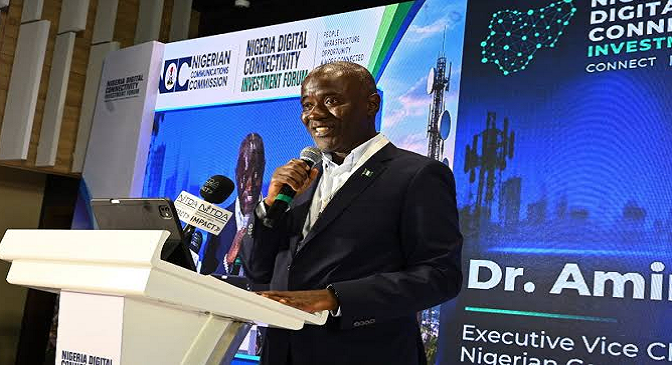
*The Nigerian Communications Commission discloses the participants in the Nigeria Digital Connectivity Investment Forum 2026, in Abuja, recognised that principal barriers identified, stating these are interconnected, and require coordinated action for solutions from across government, regulators, investors, financiers and industry
Gbenga Kayode | ConsumerConnect
Following its successful organisation and hosting of the Nigeria Digital Connectivity Investment Forum 2026, in Abuja, FCT, the Nigerian Communications Commission (NCC) has said the participants recognised the key barriers identified across the forum.
The theme of the Forum held September 29-30, 2927 was: “Unlocking Infrastructure Investment through Data, Transparency and Partnerships”.
Konga activates Nigerian Defence discount scheme as freedom sale offers consumers 66 percent
ConsumerConnect reports the NCC disclosed the industry stakeholders, experts and investors identified the cost and tenor of financing, Right of Way (RoW) and permitting constraints, the cost and reliability of power, and gaps in trusted infrastructure data in the country’s digital ecosystem.
According to the telecoms sector regulatory Commission, the participants during panel sessions, presentations, and roundtables, were able to establish that these variables “are interconnected and require coordinated action across government, regulators, investors, financiers and industry.”
The NCC stated that it undertook to sustain engagement with participants and relevant stakeholders towards advancing the identified actions and investment pathways at the Forum.
The Commission, which convened the Forum in collaboration with Swedfund and Ookla, said among other major objectives, it organised the event to set out national digital infrastructure and investment priorities; present Nigeria’s connectivity and market data, including the Nigeria Digital Connectivity Index, as a basis for transparent planning.
The NCC further noted that the Forum examined what makes digital infrastructure bankable; showcase new models that reduce cost or extend reach; and convene investors, regulators, policymakers and operators to agree concrete opportunities.
Mrs. Nnenna Ukoha, Director of Public Affairs Department at NCC, Sunday, October 4, in a communiqué issued at the end of the Forum also noted a number of decisions arrived at during discussions at the Nigeria Digital Connectivity Investment Forum 2026.
The communiqué stated as follows:
Preamble
The Nigerian Communications Commission (NCC), in partnership with Swedfund and Ookla, convened the Nigeria Digital Connectivity Investment Forum 2026 at the Onomo Allure Hotel, Abuja, on September 29-30, 2026, under the theme “Unlocking Infrastructure Investment through Data, Transparency and Partnerships”.
Day 1 addressed Data, Demand and Infrastructure Investment Opportunities; Day 2 addressed Financing, Partnerships and Action Pathways, and closed with Investment Partnership and Investor Access Roundtables at which participants agreed the priority actions set out below.
The Forum was attended by the Honourable Minister of Industry, Trade and Investment; representative of the Honourable Minister of Communications, Innovation and Digital Economy; the Ambassador of Sweden to Nigeria; heads of Federal agencies; development finance institutions, investment banks and institutional investors; mobile network operators, tower and fibre infrastructure companies, satellite and fixed wireless providers; original equipment manufacturers; industry associations; and Management and staff of the Commission.
The Forum provided a platform for government, regulators, investors, financiers, infrastructure providers and other stakeholders to examine Nigeria’s digital infrastructure investment opportunities, identify barriers to deployment and financing, and agree practical actions for accelerating investment and expanding meaningful connectivity.
Participants benefited from important perspectives from leading figures in Nigeria’s investment and financial sectors.
On Day 1, Mr. Bolaji Balogun, Chief Executive Officer of Chapel Hill Denham, provided an investor perspective on “Financing Digital Infrastructure,” emphasising the importance of investable projects, appropriate financing structures, capital-market participation and conditions that can attract long-term private and institutional capital.
On Day 2, Mr. Bismarck Rewane, Chairman of the Board of FCMB and Managing Director of Financial Derivatives Company, provided insights on the broader economic and financial environment for infrastructure investment.
Bismarck highlighted the importance of cost and availability of capital, investor confidence, policy predictability and the role of digital infrastructure in supporting productivity and economic growth.
Objectives
The Forum was convened to: set out national digital infrastructure and investment priorities; present Nigeria’s connectivity and market data, including the Nigeria Digital Connectivity Index, as a basis for transparent planning; examine what makes digital infrastructure bankable; showcase new models that reduce cost or extend reach; and convene investors, regulators, policymakers and operators to agree concrete opportunities.
Observations
Following the presentations, panel discussions and investment roundtables, participants observed that:
Demand is outgrowing the networks:
Nigeria consumed about 1.6 million terabytes of data in July 2026, an increase of almost 47% in twelve months, and subscriptions are projected to grow from about 195 million towards 350 million within ten to fifteen years.
Cloud computing and artificial intelligence will place further demand on networks, data centres and, above all, power.
Digital connectivity is economic infrastructure: Telecommunications and information services accounted for 9.72% of Nigeria’s real GDP in the second quarter of 2026, and mobile contributed about USD 240 billion to Africa’s economy in 2025.
The future of trade is digital, and Nigeria, as Co-Champion of the AfCFTA Protocol on Digital Trade and the first state party to ratify it, is positioned as a platform from which to serve the African market.
Usage, rather than coverage, is now the larger gap: Mobile broadband covers about 90% of Nigerians, yet smartphone ownership stands at about 27% and Broadband penetration at 57.4% against a 70% target. Device affordability, digital skills and trust are the binding constraints, and coverage investment alone cannot close them.
Independent evidence reduces investor uncertainty:
The collaboration between the Commission, Swedfund and Ookla provides a granular picture of the connectivity people experience.
National gains do not, however, reveal which constraint limits experience in a given location: the approach should be to screen nationally, validate locally, and verify after intervention.
Power and the middle mile are the binding constraints on deployment:
For tower companies’ power is not a side business but the business, and the cost of inland connectivity confines datacentre and internet service investment to a few metropolitan centres.
Energy and connectivity investment should be planned together, with tower clusters recognised as anchor off takers for distributed generation.
Long-life assets require long-tenor capital:
Digital infrastructure has an asset life of twenty to thirty years and cannot be financed on five-year bank tenors.
Infrastructure financing in Nigeria has grown from under ₦70 billion in 2004 to ₦19.4 trillion in 2025, and access to that capital rests on governance, management capacity and predictability.
Long-term financing is not, however, automatic bankability.
State-level conditions determine the pace of deployment:
The pilot of the Nigeria Digital Connectivity Index across twelve States shows Right of Way reform translating directly into fibre growth of between 22% and 95% in reforming States, with twelve States now charging zero, up from seven in December 2024.
New deployment models are available now:
Shared rural networks, satellite services delivered to unmodified handsets, micro-cabling, solar-powered rural sites and local device and SIM manufacturing all reduce the cost of reaching the unserved.
None removes the need for affordable devices in user’s hands.
Resolutions and Recommendations
Participants resolved and recommended as follows:
The Federal Government should accelerate the delivery of Project BRIDGE, the 90,000 km national fibre backbone, as a strategic response to the middle-mile connectivity gap; advance complementary measures to improve the availability and reliability of power for digital infrastructure; sustain policy consistency; and support financing structures that reduce the cost of capital for the sector.
The Nigerian Communications Commission should sustain the reforms already improving investment conditions, including the tariff realignment, the designation of critical national information infrastructure and Right of Way engagement with States; publish the first national Nigeria Digital Connectivity Index report; advance open-access and wholesale regulation; and finalise the direct-to-device framework.
State Governments should cut and harmonise Right of Way and site permit charges, adopt the Federal model under which the operator that lays fibre reinstates the road, and shorten permitting timelines.
Operators, infrastructure and technology companies should pursue shared-infrastructure and neutral-host models that lower the cost of rural and indoor coverage, and pair every coverage investment with measures that put affordable devices in users’ hands, including locally manufactured devices and SIMs.
Investors and development finance institutions should match long-life assets with long-tenor naira capital, tie infrastructure funding to independently verified network performance, and use blended structures and credit enhancement to bring projects that are not yet commercially ready to market.
Priority Actions and Partnership Pathways
From the roundtables, participants agreed the following priority actions, with the period within which each should be taken:
Within six months
Secure funding for community co-owned rural networks powered by renewable energy in zero-connectivity communities, through partnership with the Universal Service Provision Fund, State governments and the Rural Electrification Agency.
Within six to eighteen months
Issue open-access and wholesale regulation, publish a wholesale rate card and complete the broadband mapping.
Give the Universal Service Fund regulatory backing as the primary source for underserved-area projects, supported by blended public and multilateral funding.
Build the business case for indoor coverage in commercial buildings, with tower companies, neutral hosts and property owners.
Capture data-centre requirements in the National Broadband Plan, pairing off-grid and renewable power with blended finance.
Within eighteen to twenty-four months
Establish a financing framework for telecommunications power, standardising energy provision by regulation and bringing it within critical national information infrastructure protection.
Develop metro and access fibre under concession, mapped against existing assets and integrated with Project BRIDGE.
Way forward
Participants recognised that the principal barriers identified across the Forum—the cost and tenor of financing, Right of Way and permitting constraints, the cost and reliability of power, and gaps in trusted infrastructure data—are interconnected and require coordinated action across government, regulators, investors, financiers and industry.
The Nigerian Communications Commission undertook to sustain engagement with participants and relevant stakeholders towards advancing the identified actions and investment pathways.
The communiqué noted the NCC affirmed the participants expressed appreciation to the Federal Government of Nigeria, the Honourable Ministers, the Government of Sweden, Swedfund and Ookla for “their partnership, and to the Board, Management and staff of the Nigerian Communications Commission for convening and hosting the Forum.”
Pingback:INEC set to hold World Press Conference on 100-day countdown to 2027 Elections - Consumer Experience Is A Top Priority