


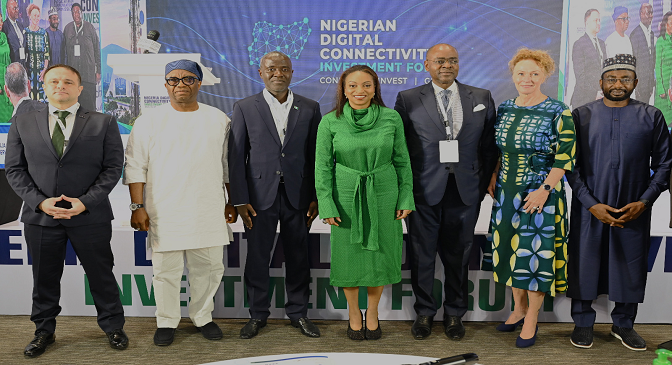
*The Nigerian Communications Commission urges industry stakeholders to accelerate public, private sector investments in telecoms infrastructure, to deepen Broadband expansion, improve service quality, and support the burgeoning Nigeria Digital Economy
Gbenga Kayode | ConsumerConnect
As part of efforts at accelerating Broadband expansion in the country’s digital space, the Nigerian Communications Commission (NCC) and other industry stakeholders have urged increased public and private sector investments in telecoms infrastructure in the country.
The NCC said increased investments in the all-important sector of the economy would enhance service quality, raise the quality of consumer experience, and support the growing Nigeria Digital Economy.
ConsumerConnect reports Dr. Aminu Maida, Executive Vice-Chairman and Chief Executive Officer (EVC/CEO) of the Commission, stated this in his address at the opening of the maiden Nigeria Digital Connectivity Investment Forum (NDCIF), in Abuja, FCT.
The NCC organised the event in conjunction with Swedfund and Ookla.
Dr. Maida, in his address, said the forum was designed to provide a strategic platform for fostering dialogue between regulators, investors, infrastructure providers, and development partners.
The forum, the EVC/CEO noted, was planned to examine the investment requirements needed to expand connectivity, identify barriers to infrastructure deployment, and explore partnerships capable of accelerating digital transformation and economic development.
Insight into Nigeria’s telecoms success story, by Maida
The NCC Chief also emphasised that the overarching objective of mobilising investments is to improve connectivity, stimulate economic growth, and enhance the quality of life of Nigerian digital consumers.
Nigeria’s telecommunications success story over the last twenty-five years has demonstrated the transformative impact of sound policy, transparent regulation and investor confidence, stated he.
According to him, the liberalisation of the telecommunications sector and the introduction of transparent licensing processes have equally encouraged private sector participation, leading to unprecedented growth in connectivity and communications services across the West African country.
Mrs. Nnenna Ukoha, Director of Public Affairs at NCC, Tuesday, as well quoted Maida in a statement to have explained: “The experience of the last two-and-a-half decades underscores the importance of creating an enabling environment for investment.
“As a regulator, the Commission remains committed to facilitating investment while ensuring consumer protection and promoting fair competition.”
The EVC/CEO observed that the demand for reliable digital connectivity continues to rise as individuals, businesses, educational institutions and public services increasingly depend on broadband-enabled technologies to function effectively.
On growth of cloud services, data stats and AI applications
The NCC Executive Vice-Chairman said that the growing adoption of cloud-based services, digital platforms and Artificial Intelligence applications would further increase the need for robust and resilient telecommunications infrastructure.
Highlighting the scale of this demand, Dr. Maida disclosed that data consumption in Nigeria increased from approximately 1.13 million terabytes in July 2025 to about 1.66 million terabytes in July 2026, representing a growth of nearly 47 percent within one year.
He stressed that sustaining this level of growth would require significant investments in network expansion, modernisation and quality-of-service improvements.
As regards the need for improved Quality of Service (QoS) for consumers, the EVC/CEO of NCC stated: “The investment challenge before us is not merely one of expanding coverage.
“It is also about ensuring that those already connected enjoy better service quality, improved user experiences, and infrastructure capable of supporting future technologies.”
Some recent NCC’s regulatory affairs
Maida disclosed that among the measures already implemented, the telecommunications tariff adjustment approved in 2025 to support operators’ capacity for network investment and service improvement is one
According to him, there also ongoing engagements with state governments on Right of Way (RoW) issues, and the designation of telecommunications infrastructure as Critical National Information Infrastructure (CNII) by President Bola Ahmed Tinubu few years back.
These initiatives, he said, are aimed at reducing barriers to network deployment and enhancing investor confidence in the sector.
Commission invites investors to tap into emerging opportunities in telecoms
Maida emphasised the Commission’s determination to strengthen evidence-based regulation as a means of improving transparency, enhancing regulatory certainty and providing clearer insights into investment opportunities within the telecommunications sector.
He, therefore, urged local and international investors, development finance institutions, infrastructure providers and industry stakeholders to take advantage of emerging opportunities within Nigeria’s telecommunications sector and partner with the Commission in expanding digital connectivity across the country.
Maida said: “The investment we advance today must ultimately translate into better opportunities for Nigerians, improved access to services, and a stronger digital economy that supports sustainable national development.”
The Chief Executive of the Commission commended Swedfund and Ookla for their strategic partnership and contributions toward the successful organisation of the forum, noting that both organisations have played critical roles in supporting the Commission’s efforts at deepening data-driven decision-making and improve understanding of connectivity realities across Nigeria.
Why NCC’s strategic collaboration with Swedfund, Ookla
Highlighting the Commission’s partnership with Swedfund and Ookla,
Dr. Maida stated the collaboration with the two organisations has provided independent insights into the actual connectivity experience of consumers, and supported the Commission’s efforts at identifying service gaps, monitoring network performance, and assessing areas requiring additional investment in the telecoms.
He explained that data generated through the partnership is being integrated with other markets and network information to provide a more comprehensive understanding of infrastructure needs and investment opportunities across the country.
On objectives of Consumer Data Lab
The NCC Chief Executive also discussed the fundamental role of the Commission’s Consumer Data Lab, funded by the Gates Foundation and developed in collaboration with Innovations for Poverty Action (IPA).
The NCC Chief disclosed that the platform integrates Ookla’s network performance data, consumer complaints and operators’ intervention reports into a single dashboard that enables deeper analysis of connectivity issues by location and demographic characteristics.
He said: “This helps us investigate service problems and assess whether operators’ interventions have improved consumers’ experience.
“It also gives us a more useful picture of where further deployment or network upgrades may be needed.
“We want investors to benefit from that understanding, and from regulatory decisions that are clear, proportionate and supported by evidence.”
Minister: Digital Infrastructure as a driver of investment climate, trade
Delivering her keynote address at the Forum, focusing on “Connectivity and Competitiveness: Digital Infrastructure as a driver of Investment Climate and Trade, the Honourable Minister of Industry, Trade and Investment, Dr. Jumoke Oduwole, Honourable Minister for ITI, lauded the NCC and its partners for convening the investment forum.
The Minister stressed that the conversation is about infrastructure required to produce, connect, invest and trade in a modern economy.
Dr. Oduwole said the forum was timely as the quality of a country’s digital infrastructure increasingly determines the quality of investment climate, the competitiveness, and ability to participate meaningfully in international trade.
She explained this is because the future of trade is now digital.
According to her, the nature of trade has changed as today “private networks, data centres, digital platforms, and secure data systems are critical for transactions.”
In her remarks on the occasion also, Anna Westerholm, Swedish Ambassador to Nigeria, acknowledged significant gaps in connectivity coverage, quality, affordability and supporting infrastructure, and stressed that government, industry and investors would need to work together to address them.
Westerholm stressed that data on network performance and user experience could help to identify areas requiring investment, reduce uncertainty and strengthen investor confidence while identifying energy, cybersecurity and digital skills as important components of a sustainable connectivity ecosystem.
The Swedish envoy also said: “Sweden is interested in deepening commercial and investment relations with Nigeria, particularly in digitalisation and connectivity. Swedish institutions and companies could contribute technology, commercial expertise, development finance, export financing and project development to support Nigerian infrastructure priorities.”
Commenting earlier on the forum Tristan Muhader, VP of Sales, Middle East & Africa, Ookla said: “Connectivity is no longer simply the channel through which we make calls or browse the internet.
“It is becoming the operating layer for economic and public activity across sectors, from essential services to AI.
“That makes its performance and resilience a national priority’.
Ambassador Westerholm further stated that “through our collaboration with the NCC, Ookla contributes independent, crowdsourced intelligence that reveals the experience people receive and helps identify where infrastructure investment can have the greatest impact.”
She explained: “This intelligence can also help authorities understand the impact of disruptions and verify recovery.
“The forum is an opportunity to turn shared evidence into smarter investment, stronger national digital resilience and a more competitive digital economy for Nigeria.”
Adetunji Adeyemo, Director of the National Frequency Management Council, representing Dr. ‘Bosun Tijani, Honourable Minister for Communications, Innovation and Digital Economy (FMCIDE), said reliable, affordable, resilient and accessible digital infrastructure was essential to Nigeria’s economic transformation.
Adeyemo noted the Nigerian Government had identified infrastructure, policy and innovation, entrepreneurship and capital as key strategic priorities.
The two-day forum brings together policymakers, investors, development finance institutions, telecommunications operators, infrastructure providers, technology companies, and development partners to explore opportunities for investment in digital connectivity across Nigeria.
Pingback:Tinubu returns to Nigeria after 4-week holiday in France - Consumer Experience Is A Top Priority
Pingback:NASENI clarifies media reports on campus 30 percent contract mobilisation fee - Consumer Experience Is A Top Priority
Pingback:Dangote Refinery boost investor confidence as firm targets $36bn revenue 2026 - Consumer Experience Is A Top Priority
Pingback:2027: Why opposition candidates, supporters in Zamfara, Plateau, 2 others join APC –Official - Consumer Experience Is A Top Priority
Pingback:2027: INEC announces PVC collection begins October 9, warns staff against compromise, partisanship - Consumer Experience Is A Top Priority
Pingback:Economy: CBN urges consumers to handle Naira with care, dignity - Consumer Experience Is A Top Priority
Pingback:FirstBank reassures customers of security of FirstMobile App - Consumer Experience Is A Top Priority
Pingback:Tijani, Westerholm, Oyedele, others headline maiden Nigeria Digital Connectivity Investment Forum - Consumer Experience Is A Top Priority