


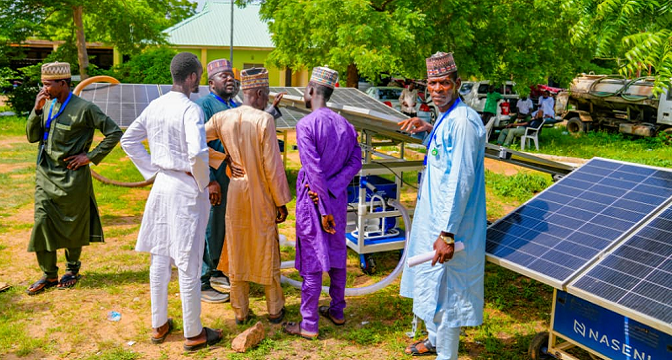
*The National Agency for Science and Engineering Infrastructure organises the state-of-the-art solar irrigation pump system in collaboration with stakeholders, and various farm cooperatives societies, to increase adoption of solar irrigation systems by farmers across the Northern state
Isola Moses | ConsumerConnect
The National Agency for Science and Engineering Infrastructure (NASENI) has demonstrated its state-of-the-art solar irrigation pump system to farmers in Kano State, Northern Nigeria.
NASENI said the event showcased climate-resilient solutions to dry season farming and post-harvest losses in the commercial city.
The market-oriented agency also disclosed the community demonstrations held Wednesday, September 2, 2026, at large-scale rice farmlands in Zakirai village, in Gabawasa Local Government Area (LGA) and Kwarin Kaba, Kumbotso LGA of the state, proved that its Solar Irrigation System offers a transformative, climate-resilient solution that reduces operational costs and decouples production from fossil-fuel volatility.
The programme organised by NASENI in collaboration with the International Water Management Institute (IWMI), CGIAR, Kano State Ministry of Agriculture, Kano State Agricultural Development Authority (KNARDA), and various farm cooperatives societies in the state was aimed at increasing adoption of solar irrigation systems by farmers.
Mr. Olusegun Ayeoyenikan, Director of Information at NASENI, in a statement, Thursday, September 3, 2026, said Engr. Dr. Emmanuel Ajani, Director of Technical Services of the agency, who led the farm demonstrations.
Ajani used NASENI’s solar irrigation pump machines, noting that Nigeria possesses estimated 84 million hectares of arable land.
However, an overwhelming majority of its agriculture remains rainfed, with only a fraction under functional irrigation, stated he.
The Director of Technical Services at NASENI said: “In Northern Nigeria, specifically Kano State, climate variability and rising fuel costs (exacerbated by subsidy removals) heavily threaten the profitability of dry-season farming (rice, wheat, and high-value vegetables).
“This is why we organised a two-day “Demand-Supply Linkage Workshop and Field Demonstrations for Solar-Based Irrigation Systems (SBIS).”
He equally noted: “This workshop brought together the Demand (structured farmer clusters), Supply (solar vendors), and Enablers (non-interest banks, conventional banks, NIRSAL, and extension agents) to catalyse bankable investments and directly translate research into actionable equipment adoption.
“This Demand-Supply Linkage Workshop is designed to bridge this gap.”
Speaking at the event also, Dr. Farouk Ahmad Kurawa, Managing Director of Kano State Agricultural Development Authority (KNARDA), lauded NASENI for organising the workshop and farm demonstrations which provided a platform for equipment suppliers to showcase certified, quality-assured SBIS technologies directly to farmers.
It said that farmers were willing to adopt new innovations.
A farmer, Mr. Zubairu Mohammed Inuwa, from Kwarin Kaba, Kumbotso LGA on whose farmland NASENI’s Solar Irrigation system was demonstrated, lauded the Agency for developing such a technology that would ensure all-season farming, increase crop yields, reduce post-harvest losses and increase income for farmers.
Dr. Adebayo Oke, Team Lead, International Water Management Institute (IWMI), said recent CGIAR baseline studies and Discrete Choice Experiments (DCE), in Kano, Kaduna, and Kebbi reveal significant adoption barriers.
While the Solar-Based Irrigation Systems technology is desired, the upfront capital cost is prohibitive for individual SmallHolder.
Dr. Oke stated: “That is why we are working with NASENI.
“And the primary objective is to establish a functional, sustainable market linkage among smallholder farmer cooperatives, solar irrigation equipment suppliers, and financial institutions to accelerate the adoption of Farmer-led Irrigation Development, FLID/SBIS in Kano State and others.”
Financial institutions who participated in the programme include Bank of Agriculture (BOA), Jaiz Bank, Nigeria Incentive-Based Risk Sharing System for Agricultural Lending (NIRSAL) to co-develop acceptable, harvest-synced credit facilities and Islamic finance products.
Representatives from the various Vegetable Farmers Association of Nigeria, Rice Farmers Association of Nigeria (RIFAN), Cooperative societies, local vegetable/tomato farming clusters, Women and Youth Farming Groups participated, and also attested to the economic viability of solar-based irrigation systems.