


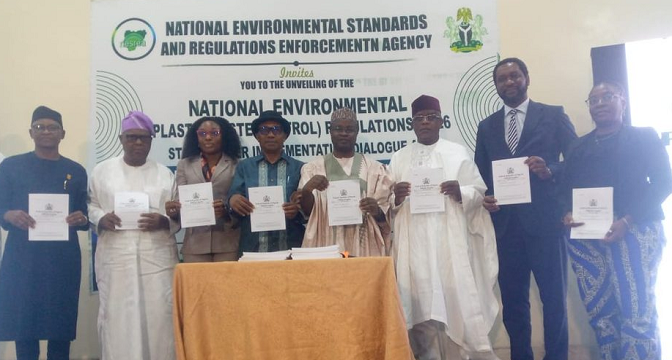
*Balarabe Abbas Lawal, Minister for Environment, introduces the National Environmental (Plastic Waste Control) Regulations, 2026, explaining the new regulations are not designed to declare war on plastics but task stakeholders in plastics value chain to take responsibility for wastes generated by their products in the Nigerian economy
Gbenga Kayode | ConsumerConnect
As part of practical measures to address plastic pollution, protect human health and the environment, as well as drive a circular economy, the Federal Government of Nigeria Thursday, September 3, 2026, unveiled the National Environmental (Plastic Waste Control) Regulations, 2026, in Abuja, FCT.
ConsumerConnect reports the government, however, has introduced tougher measures to curb plastic pollution.
GITEX Nigeria launches Mint Africa as Lagos stakes claim on future of finance
The West African country now compels producers, importers, brand owners, recyclers, waste managers, and other players in the plastics value chain to take responsibility for the waste generated by their products in the circular economy.
Core objectives of new plastic waste regulations
The government emphasised other core objectives of the National Environmental (Plastic Waste Control) Regulations to include shifting the country from a “produce, use, and dispose” model to recovering and reusing plastic waste for economic purposes.
It is noted that the decisive shift from treating plastic waste as somebody else’s problem now emphasises making “every actor” responsible for what they produce, import, use, and discard.
The regulatory framework is further designed to substantially reduce plastic wastes, Nigeria reportedly generates about 2.5 million tonnes of wastes yearly.
Minister speaks on improved regulatory framework
Balarabe Abbas Lawal, Honourable Minister for Environment, introduced the new policy.
Lawal, represented on the occasion by Salihu Aminu Usman, Permanent Secretary of the Ministry of Environment, said the regulations were not intended to declare war on plastic.
The Minister rather explained that plastic remained essential to healthcare, food preservation, manufacturing, agriculture, transportation and other sectors of the economy.
Lawal, however, said the real problem was irresponsible production, consumption and disposal of plastic products.
Nigeria needs a science-based, inclusive and enforceable framework that will protect the environment without undermining economic activities or placing an unfair burden on vulnerable consumers, stated he.
Who are responsible for plastic waste management in Nigeria?
The Minister also emphasised that the regulations strengthen existing government initiatives on plastic waste management.
The existing ones, he noted, include the National Policy on Plastic Waste Management, Extended Producer Responsibility Guidelines and the Single-Use Plastics Guidelines.
According to him, under the new regime, producers, importers and other operators placing plastic products on the Nigerian market would be required to take responsibility for the products after their useful life.
Lawal said the regulations covered the entire plastics value chain, from producers and importers to consumers, recyclers and waste managers, with prescribed requirements for plastic packaging and the use of recycled materials.
On sachet water waste management
Speaking on sachet water, Minister Lawal announced the new regulations did not amount to an immediate ban of products.
He, nonetheless, noted that the framework requires sachet wastes to be managed within the Extended Producer Responsibility framework.
According to him, over 60 million Nigerian consumers depend on affordable packaged water daily.
Lawal further averred that the environmental transition, therefore, must be economically realistic and socially just to the citizenry.
On the flip side, the Minister disclosed plastic wastes should also be viewed as “an economic resource” capable of creating jobs and investment opportunities through recycling, material recovery, and the development of circular markets.
NESREA: Regulations address producer accountability, credible recycling
Speaking at the presentation of the new regulations in Abuja, Prof. Innocent Barikor, Director-General of NESREA, said the unveiling of the document marked a transition from policy intention to implementation.
Barikor said regulation alone could not solve plastic pollution without functional systems, responsible markets, innovation, investment and collaboration across the value chain.
The NESREA Chief also noted the strengthening of the National Producer Registry and Extended Producer Responsibility architecture would be critical to ensuring producer accountability and building credible recycling and recovery systems.
The inaugural “Less Plastic in Water” Multi-Stakeholder Roundtable was designed to develop practical and sustainable alternatives to avoidable single-use plastics, particularly sachet water packaging, he stated.
Regulatory infractions to attract sanctions, says Lawal
Lawal, Minister for Environment, therefore, warned that a regulation without enforcement was merely a “wish written on paper.”
He emphasised that violators would face sanctions, including financial penalties, imprisonment and personal liability for responsible officers where applicable in the country.
Operators already engaged in plastic-related activities, he disclosed, have been given a compliance window to obtain the required permits and registrations.
He noted the period was a grace period for compliance, and not an invitation to delay enforcement of the regulations.
Lawal as well urged stakeholders to work together, and transform plastic wastes from an environmental burden into a source of raw materials, jobs and economic opportunities for Nigerians.
Implementation of the improved regulations ultimately, is about building a healthier, more prosperous and sustainable Nigeria, stated the Minister for Environment.