


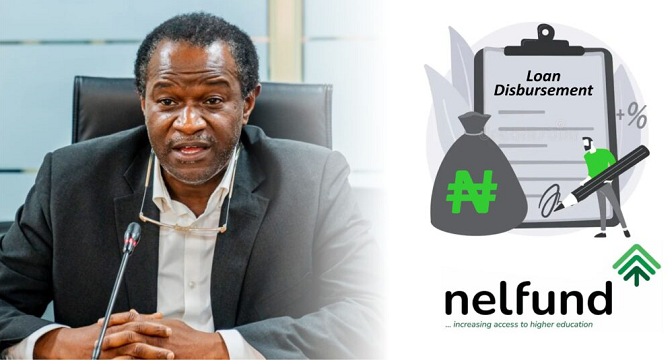
*Nigeria’s Students Loans (Access to Higher Education) Act, 2024 regulating the Nigerian Education Loan Fund highlights the beneficiaries will not be required to repay more than 10 percent of their gross monthly income, disclosing approximately 850,000 beneficiaries have taken advantage of the scheme, and ₦303.9 billion already disbursed thus far
Isola Moses | ConsumerConnect
In accordance with the repayment framework established by the Students Loans (Access to Higher Education) Act, 2024, beneficiaries of the Nigerian Education Loan Fund (NELFUND) will not be required to repay more than 10 percent of their gross monthly income in the country.
The provision in the Act was formulated to prevent education-loan repayments from placing excessive financial pressure on graduates as they transition from school into employment.
ConsumerConnect reports the 2024 Act established NELFUND as the Federal Government’s vehicle for providing loans to Nigerians pursuing higher education, vocational training and skills acquisition.
Under the law, repayment begins after a beneficiary has completed the course of study and secured employment.
Loan repayment process for student beneficiaries
The Act, however, noted the monthly deduction could not exceed 10 percent of the beneficiary’s gross income until the loan, and applicable charges have been fully repaid.
This means repayment is linked directly to income rather than a fixed monthly amount.
For example, a beneficiary earning a gross monthly income of ₦200,000 would have a maximum repayment obligation of ₦20,000, while a beneficiary earning ₦500,000 could repay up to ₦50,000 per month.
It is equally stated that repayment does not start immediately after graduation.
The provision particularly provides beneficiaries with time to transition into employment before NELFUND could begin enforcement action. NELFUND cannot initiate enforcement proceedings against a beneficiary until two years after completion of the National Youth Service Corps (NYSC), programme or exemption from it.
A beneficiary may, however, voluntarily begin repayment before completing the course. The legislation also provides protection for graduates who remain unemployed or have no income.
Where a beneficiary is unemployed and has no income, the person may apply to NELFUND for an extension by submitting a sworn statement in the manner prescribed by the Fund.
However, the law provides sanctions for anyone who submits a false statement to NELFUND.
A person convicted of making a false declaration may face imprisonment for up to three years.
The repayment framework comes as the student-loan programme continues to expand. NELFUND disclosed that, as of July 3, 2026, it had processed 1,635,676 applications and recorded approximately 850,000 unique beneficiaries.
The distinction is important because some students have had more than one application processed.
The approximately 850,000 unique beneficiaries, therefore, represent individual students who have benefited from the scheme rather than the total number of applications handled by the Fund.
₦303.9 billion disbursed to beneficiaries
NELFUND has so far disbursed ₦303.9 billion to beneficiaries. Of that amount, ₦190 billion has gone towards institutional charges, while ₦113.8 billion has been provided as upkeep support to eligible students.
The figures underscore the growing scale of the Federal Government’s student-financing programme and the substantial funding required to sustain it.
Why student loan repayment matters
NELFUND is designed to operate not simply as a government grant programme, but as a revolving education-financing institution.
Under the Act, the Fund is required to recover debts owed to it, and maintain a diversified pool of funds for providing loans to qualified applicants.
The Act recovered loans are expected to form part of the resources available to finance future beneficiaries.
NELFUND is empowered to recover outstanding loans through legal means, including debt-recovery proceedings.
The Fund’s General Reserve Fund is expected to receive money from several sources, including one per cent of taxes, levies and duties collected by the Nigeria Revenue Service (NRS), accruing to the Federal Government; appropriations by the National Assembly (NASS); loan repayments; investment income; government funding; proceeds from education bonds, and other debt instruments; donations; grants; and endowments.
The Fund may use the General Reserve Fund to provide loans for tuition, fees, other approved charges and upkeep, as well as meet authorised operational expenses.
Besides, NELFUND is also required to maintain proper accounts and records.
Its accounts must be audited annually by an independent firm of auditors, while its annual report is to be published within six months after the end of each financial year and submitted to the President and National Assembly.
Employers have a role in loan recovery
The Act also places responsibilities on employers.
Every prospective employer is required to enquire from NELFUND about the student-loan status of a person they intend to employ.
Where NELFUND informs an employer that the employee is a loan beneficiary who has not completed repayment, the employer must provide information required by the Fund to facilitate collection of the outstanding loan and applicable charges.
Employers who contravene the provision may face a fine of at least ₦2 million, imprisonment for at least one year, or both.
The arrangement effectively ties repayment to a beneficiary’s earnings, meaning higher-income graduates would make larger repayments while those earning less would make proportionately smaller payments.
How to apply for a NELFUND loan
Prospective beneficiaries can apply through the Nigerian Education Loan Fund portal.
Applicants should begin by visiting the NELFUND portal and selecting “Apply Now.”
They will be required to provide their National Identification Number (NIN), and JAMB registration number before selecting their public tertiary institution, entering their matriculation number and verifying their date of birth.
Applicants can then create an account by providing an email address and setting a secure password.
A verification link is sent to the applicant’s email address.
After activating the account, applicants should log in and complete their personal information, including their current telephone number and residential address.
They must also provide their Bank Verification Number (BVN), and details of their bank account. Applicants should save their completed profile before proceeding to the loan request.
Applying for institutional charges and upkeep
To request funding, applicants should select “Request for Student Loan.”
Applicants seeking institutional charges should select the relevant option and provide the required information and supporting documents, including an admission letter where applicable.
Students seeking upkeep support should note that the upkeep loan is linked to the institutional-charges application.
Applicants should carefully review the declaration and terms and conditions before submitting the application.
What the 10 percent rule means for graduates
According to NELFUND, the repayment structure established by the 2024 Act is intended to strike a balance between access to education and recovery of public funds.
Graduates are given time to complete their studies, undertake NYSC where applicable, secure employment, and establish an income before enforcement can begin.
Once repayment becomes due, the law limits the monthly deduction to 10 percent of gross income, providing a statutory ceiling on the amount that can be recovered from a beneficiary’s earnings.
For NELFUND, however, the major challenge will be developing an effective recovery system capable of tracking beneficiaries after graduation, identifying those who have secured employment and collecting repayments efficiently.
With approximately 850,000 beneficiaries and ₦303.9 billion already disbursed, the effectiveness of that recovery system could become increasingly important to the future of the scheme.
Ultimately, the sustainability of NELFUND will depend on both continued funding and the successful recovery of loans from graduates who enter employment, report stated.
If the system works as intended, recovered funds can be recycled into new loans, allowing more Nigerians to access higher education, vocational training and skills development without facing the burden of paying the full cost of education upfront, according to report.