


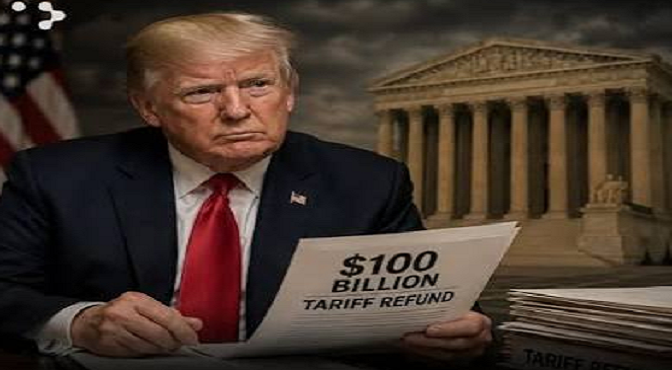
*American consumers, who purchased imported appliances, in 2025, paid more because of President Donald Trump administration’s tariffs, but may not benefit from money the United States Government is refunding to businesses while some consumer groups may take matter to court
Gbenga Kayode | ConsumerConnect
Amid inflationary trend in the American country’s economy, the United States (US) Government has returned about $100 billion of about $166 billion earlier collected from companies and businesses under President Donald Trump’s invalidated emergency tariffs 2025.
ConsumerConnect gathered the Federal Government refunded the huge refund in tariffs to businesses after the US Supreme Court struck down a central part of President Trump’s trade programme.
Public Health: NDLEA alerts parents to illicit drug-infused cookies, gummies in Nigeria
However, for consumers, who paid higher prices for imported products while the duties were in effect last year, their compensation remains far from certain as of now, agency report said.
The payments represent about 60 percent of the roughly $166 billion collected under tariffs Trump has imposed, using the International Emergency Economic Powers Act, or IEEPA.
In February 2026, the Supreme Court ruled that the emergency-powers law did not authorise Trump to impose tariffs, clearing the way for importers to recover the duties.
The court’s decision, nevertheless did not itself establish a consumer-refund system.
Key responsibilities of US Customs and Border Protection
US Customs and Border Protection subsequently, created an electronic process known as CAPE to receive and validate refund requests.
ConsumerConnect reports the US Customs and Border Protection is the largest Federal law enforcement agency under the United States Department of Homeland Security.
It is responsible for securing the country’s borders, regulating international trade, collecting import duties, and enforcing customs and immigration laws.
The CBP, among others, patrols land borders and coastal waters to stop illegal entries and contraband, as well regulates international commerce and collecting lawful duties from importers.
The agency equally processes arrivals at ports of entry, airports, and checkpoints in the US, among other responsibilities.
As beneficiaries of the Federal refund arrangement, eligible American businesses must identify qualified import entries, and maintain an account in the agency’s Automated Commercial Environment, including banking information for electronic payments, report stated.
CBP’s guidance is directed toward importers and customs brokers — not individual shoppers.
Consumers on shaky legal ground
Despite the promising offer of about $100 billion to businesses, distinction determines who receives the money.
Legally, tariffs are paid to the government by the importer of record.
It is also noted that
Even when a retailer, manufacturer, or distributor raises prices to recover that expense, the consumers at the end of the supply chain does not become the tariff payer in the eyes of customs law, according to report.
Subsequently, households generally cannot submit receipts to CBP, or request a share of a company’s refund from the $100 billion refund.
The economic burden is more complicated than the legal one.
Importers may absorb a tariff through lower profit margins, negotiate lower prices from suppliers, or pass some or all of the cost to wholesalers, retailers, and consumers. Because those effects can spread across several companies — and mingle with changes in transportation, labour, and commodity costs — calculating how much tariff a particular shopper paid for a particular product can be extremely difficult.
It us, however, noted that consumers may still receive “indirect relief”, if companies use their refunds to lower prices, issue credits, or avoid future increases.
But such measures are generally voluntary. Businesses could instead apply the money to debt, wages, investment, dividends, or other expenses, and lower wholesale costs do not guarantee that retail prices will fall.
Courts may have a voice
Meanwhile, some shoppers have turned to the courts.
Class-action complaints argue that companies raised prices because of tariffs, and should not be allowed to retain both those higher revenues and government refunds at the same time.
Those cases face significant hurdles, including proving that a price increase was tied to an invalidated tariff, tracing the tariff to specific purchases, and establishing a legal duty requiring the seller to reimburse customers.
Political pressure is also building. For instance, Illinois Governor J. B. Pritzker has asked the administration to provide payments of $1,700 per Illinois family, and has advocated legislation requiring companies to pass tariff relief to consumers.
Pritzker’s proposal is a request, not an approved Federal benefit, and the relevant consumer-relief legislation has not advanced in Congress, Capitol News Illinois report said.
The requested payments will total over $8.6 billion for the state.
For now, the answer for consumers is straightforward but unsatisfying: there is no automatic federal refund, no household claims portal, and no guarantee that businesses will share the money, report stated.
However, shoppers could eventually benefit through lower prices, successful litigation, or a new act of Congress.
Unless one of those paths produces concrete relief, the government’s historic tariff repayment will remain primarily a refund to importers — even where consumers helped carry the original economic burden, according to report.