


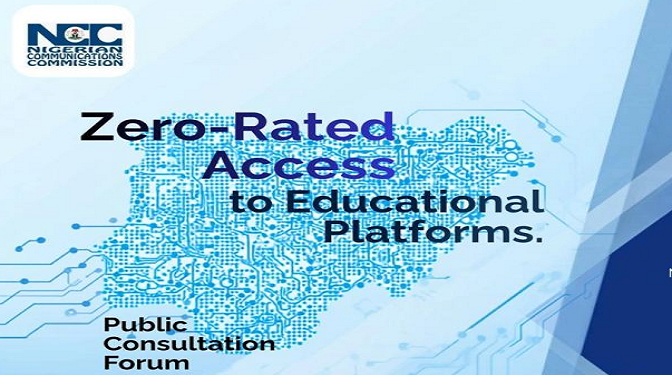
*The Nigerian Communications Commission opens a public consultation forum on a proposed digital framework christened ‘Zero-Rated Access to Educational Platforms and Content’, to allow millions of Nigerian teachers and students to access selected educational Web sites and digital learning platforms without incurring data charges
Alexander Davis | ConsumerConnect
As part of the Federal Government’s digital inclusion strategy for improved Internet access to educational Web sites and resources for enhanced teaching, learning and research, the Nigerian Communications Commission (NCC) has opened a public consultation on a proposed framework.
ConsumerConnect reports the NCC, which noted this initiative tagged, “Zero-Rated Access to Educational Platforms and Content”, in a public notice issued Monday, June 22, 2026.l, said the public consultation could allow millions of Nigerian teachers and students to access selected educational Web sites and digital learning platforms without incurring data charges.
TCN announces power disruption in 5 states, Niger Republic over routine maintenance
The telecoms sector regulatory Commission also explained the Zero-Rated Access to Educational Platforms and Content was designed to reduce the cost of online learning.
The industry regulator as well emphasised the initiative would improve digital access for students who are unable to afford regular Internet usage for education purposes.
Core objectives of public consultation on proposed framework
Highlighting the fundamental objectives of the public consultation on Zero-Rated Access to Educational Platforms and Content initiative, the Commission stressed the move is part of its commitment to a “participatory regulatory process”, involving industry stakeholders, education bodies, telecoms operators, and the public.
The notice also noted: “The Consultation Paper represents a preliminary stakeholder engagement in line with the Commission’s participatory and transparency-driven regulatory approach.”
According to the NCC, the regulatory document was released for public inputs, towards ensuring a balanced and sustainable implementation framework before final policy decisions are taken.
Tasks of Joint Committee of industry stakeholders
Outlining the core responsibilities of the stakeholders in actualising the stated objectives, the Commission disclosed that a Joint Committee of industry stakeholders had developed the proposal.
According to NCC, the Committee is equally tasked with designing an implementation structure that balances access, sustainability, fair competition and compliance with extant telecoms regulations in Nigeria.
The consultation paper, the Commission noted, also indicated the programme is a response to growing concerns over digital exclusion among Nigerian students.
It as well aligns with national efforts at strengthening digital literacy and education outcomes across the West African country.
The paper noted the Commission stated: “The Joint Committee believes that national economic growth and competitiveness will be enhanced by ensuring that Nigerian students can easily access the most current digital education platforms being used globally.”
It emphasised that eliminating affordability barriers through zero-rated access could significantly expand participation in digital learning, particularly among underserved populations.
Proposed programme implementation models
The consultation paper indicated that two implementation models are being considered, including a centralised mobile-friendly portal where approved educational content would be accessed free of data charges, and an alternative model requiring telecoms operators to whitelist selected educational platforms.
The Commission further outlined possible eligibility criteria, ranging from limiting access to senior secondary and tertiary students to extending it to all students and teachers across public and private institutions, or adopting a universal access model for anyone using approved educational platforms in Nigeria.
Stressing that each option carries cost and sustainability implications, the Commission noted that stakeholder inputs would be critical in determining the final structure.
Funding strategy
The NCC disclosed that funding options under consideration include industry-wide cost sharing, government subsidies, support from its Universal Service Provision Fund (USPF), development partner contributions and Public-Private Partnerships (PPPs).
In order to ensure sustainability of the digital cum educational initiative, the proposal has suggested an initial 12-month pilot phase, with bi-annual reviews to assess usage, network impact and effectiveness in improving access.
The telecoms industry regulator said after the pilot phase, the framework might transition into subsidised or low-cost educational data bundles for beneficiaries in the country.
The Commission, however, raised concerns about regulatory issues, including net neutrality and fair competition.
It cautioned that safeguards would be required to prevent market distortion or preferential treatment of certain platforms.
The NCC urged industry stakeholders and the general public to propose measures to ensure transparency, protect competition, and maintain the integrity of the digital ecosystem in Nigeria.
All submissions will be reviewed before a final framework is adopted, describing the consultation as a key step toward improving access to education through digital technology, stated the Commission.
The telecoms regulator said that interested stakeholders, therefore, should submit written contributions to: zeroratedconsultations@ncc.gov.ng) (mailto: zeroratedconsultations@ncc.gov.ng) on or before July 9 this year.