


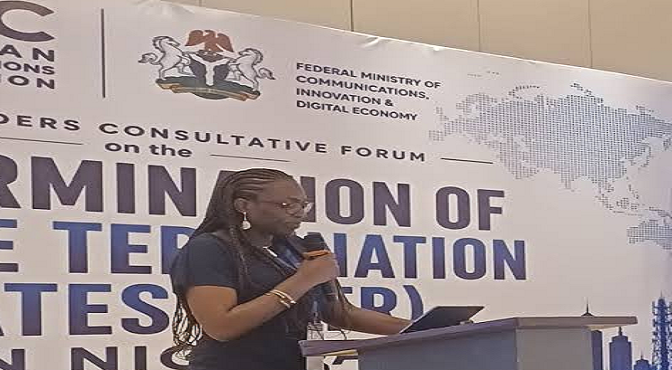
*The Nigerian Communications Commission, at a Stakeholder Consultative Forum, in Lagos, commences a comprehensive review of the telecoms industry’s Mobile Termination Rates and International Termination Rate to reflect the current socio-economic realities, inflationary trend and changing technologies in the economy
Gbenga Kayode | ConsumerConnect
In line with current socio-economic realities, including inflationary trend and changing technologies, such as Fifth Generation (5G) services and VoIP in the ecosystem, the Nigerian Communications Commission (NCC) Tuesday, June 16, 2026, held a major Stakeholder Consultative Forum to review the industry’s Mobile Termination Rates (MTRs) and International Termination Rate (ITR), in Lagos.
ConsumerConnect reports the NCC organised the forum as a consultation process, targeting several critical industry adjustments in the telecoms pricing regulatory instrument.
Online Safety: UK moves to block social media for under-16s, cites parental concerns, others
The Stakeholder Consultative Forum, in Lagos, was regarded as the first comprehensive, cost-based MTR review in eight years after the existing framework was activated 2018, designed to reflect today’s market realities, inflation, and new technologies in the entire communications industry.
It was gathered that the baseline MTR has remained at N3.90 per minute (and N4.70 for new entrants) since the last major framework put in place over eight years back.
It is also noted that industry associations, including the Association of Telecoms Companies of Nigeria (ATCON) and Association of Licensed Telecoms Operators of Nigeria (ALTON), among others over time, have advocated for retaining asymmetrical rates to protect smaller, emerging operators from dominant networks.
Core objectives of MTR review, by Mohammed
Mrs. Omotayo Mohammed, Head of Competition and Tariffs at the NCC, in her address, presented the MTR consultancy document on the review process to the participants Tuesday, in Lagos.
Mohammed described Mobile Termination Rates as the wholesale per-minute charges that a telecoms operator pays to another to complete a call on a competitor’s network in the telecoms space.
These are the fees charged by mobile operators to connect a phone call originating from a different network.
As a regulatory affair, the Nigerian Communications Commission sets rates in order to manage competition and ensure fair pricing across networks in the telecoms ecosystem.
The Head of Competition and Tariffs of the telecoms sector regulatory Commission also emphasised that the current review of the MTR framework has become necessary.
She noted the existing rates could no longer reflect prevailing economic and operational realities in the telecommunications industry in Nigeria.
Underscoring the essence of the ongoing review MTRs to stakeholders, Mohammed asserted: “The foundation of wholesale interconnection affects every stakeholder in this room.
“Misaligned termination rates can enable dominant operators to foreclose smaller competitors, deter infrastructure investment and ultimately burden consumers through inflated retail prices.”
The NCC top official as well disclosed the current MTR stands at N3.90 per minute for generic operators, and N4.70 per minute for new entrants, as the unchanged rates since 2018.
Factors responsible for telecoms pricing review
The Commission explained that significant changes in the Nigerian economy over the years, including Naira depreciation, rising inflation, and increasing energy costs have altered operators’ cost structures.
Mrs. Mohammed likewise mentioned other key factors to include advancements in technology, particularly the deployment of 5G networks, Artificial Intelligence (AI)-driven services and Internet of Things (IoTs) applications.
All these have changed network usage patterns beyond what was envisaged in the extant 2018 cost model, she noted.
Besides, the Head of Competition and Tariffs of the Commission said Over-the-Top (OTT) platforms, including WhatsApp and Telegram, are fast handling voice and messaging traffic, thereby reducing reliance on traditional interconnection services in the telecoms environment.
She revealed the Commission subsequently, engaged KPMG to undertake the consultancy and stakeholder engagement process, which is expected to last four months.
Mohammed assured the participants and Nigerian consumers at large, that the commissioned study would address issues relating to Unstructured Supplementary Service Data (USSD) services and Application-to-Person (A2P) Short Message Service (SMS).
According to her, both services have become increasingly important in the emerging Nigeria Digital Economy.
Major objectives of study cum review, by NCC
Justifying the rationale for the current review of the regulated rates, she affirmed the NCC is undertaking the review in accordance with Sections 4, 96, 97 and 108 of the Nigerian Communications Act (NCA) 2003.
The NCA 2003 mandates the Commission to promote investments, protect consumers, and ensure fair competition.
The study, she stated, would provide a cost-reflective MTR framework across different technology generations, operator categories, and clearing house arrangements in the telecoms space.
It will also review International Termination Rates (ITR) to address grey-route traffic concerns, establish a pricing framework for Mobile Virtual Network Operators (MVNOs), and assess the current asymmetric rate structure between large and new entrant operators.
Mohammed said: “The consultancy adopts an evidence-based and consultative approach. “Stakeholders will have opportunities to submit their views and validate assumptions before any determination is made.”
Aside from these, she noted the current review is expected to support retail affordability, improve access to digital financial services, and enable operators to recover costs in line with current capital and operational expenditure realities.
Consequently, transparent and cost-reflective rates will encourage infrastructure investment, and enhance investor confidence in the burgeoning Nigeria Digital Economy.
Mohammed, therefore, assured industry stakeholders that the NCC would make available its methodology, key assumptions and cost model parameters for review throughout the process, so as to ensure transparent MTR review process.