


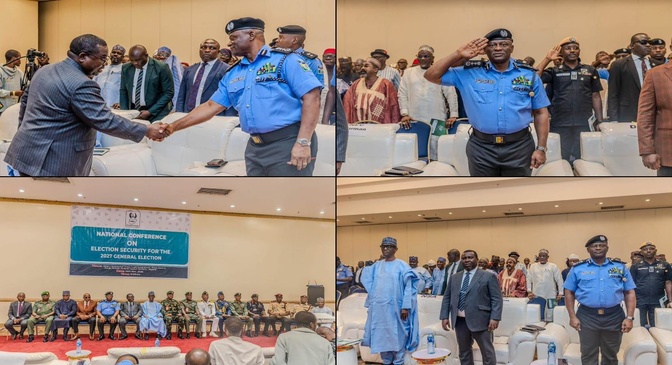
*The Independent National Electoral Commission, Office of the National Security Adviser and the Nigeria Police pledge to have a coordinated, impartial and proactive approach to securing the 2027 General Elections
Isola Moses | ConsumerConnect
The Chairman of the Independent National Electoral Commission (INEC), Prof. Joash O. Amupitan, SAN, the National Security Adviser (NSA), Malam Nuhu Ribadu, and Inspector-General of Police (UGP), Tunji Disu, have all pledged to have a coordinated, impartial and proactive approach to securing the 2027 General Elections.
The trio also condemned the recent rise in political campaign violence in recent times.
Economy: Nigeria achieves $1bn monthly remittances, sets new target for 2027 –CBN Governor
Amupitan, Ribadu and Disu spoke Thursday, November 26, 2026, in Abuja, FCT, at the INEC–Office of the National Security Adviser (ONSA) Strategic Election Security Conference.
Heads of the armed forces, intelligence, paramilitary and law enforcement agencies attended, along with National Commissioners and Resident Electoral Commissioners from the 36 States and the Federal Capital Territory (FCT).
Prof. Amupitan said the conference was meant to be “an operational war-room” and “not a ceremonial gathering”.
He described it as a platform to audit emerging threats and sharpen inter-agency coordination ahead of the polls.
The Chairman of INEC reaffirmed that only fifty-one days remain before the Presidential and National Assembly (NASS) elections Saturday, January 16, 2027.
These will be followed on Saturday, February 6, 2027, by the Governorship and State Houses of Assembly elections.
He further emphasised that electoral administration and national security are inseparable.
Amupitan said: “INEC manages the ballot; security agencies secure the environment that makes the ballot possible.”
The INEC Chief as well condemned what he described as a disturbing escalation in political intolerance and physical attacks on campaign convoys, party offices and supporters in several states since open campaigns began in August 2026.
He listed Lagos, Edo, Ekiti, Enugu, Ebonyi, Delta, Cross River, Oyo and Benue among the affected states.
“No political ambition is worth the blood of a single Nigerian,” he stressed.
The INEC Chairman also condemned the harassment of, and attacks on, INEC leadership, staff and ad hoc workers.
He said INEC officials were “non-partisan public servants discharging a sacred constitutional mandate.”
He said the Commission would “neither be intimidated nor blackmailed into compromising our neutrality”.
According to him, every attack on INEC personnel, facilities or materials would be met with the full weight of the law.
Prof. Amupitan said party leaders bear responsibility for the conduct of their candidates, campaign councils and youth wings. He described signing peace accords in Abuja while tolerating thuggery in the states as “a contradiction our democracy can no longer afford.”
Amupitan also warned that campaign violence could suppress voter turnout, endanger the deployment of over 1.41 million ad hoc personnel and poison the post-election environment. He also said it could have consequences for stability across the West African sub-region.
The INEC Chairman stressed the greatest security challenges extend beyond partisan thuggery to insurgency, banditry, separatist agitation and cultism, as well as digital threats.
These, he noted, include deepfakes, voice cloning and coordinated disinformation campaigns.
He said security planning for 2027 must therefore treat information integrity, cyber resilience and rapid counter-disinformation as frontline components of election security.
Prof. Amupitan said high-level synergy in Abuja does not automatically translate into seamless execution at the grassroots.
He urged the Resident Electoral Commissioners and Commissioners of Police to work as “co-pilots” in every state.
The Chairman of the Commission said coordination under the Inter-Agency Consultative Committee on Election Security (ICCES) must reach every Local Government Area and Registration Area. Divisional Police Officers, local Department of State Services (DSS) commanders, Nigerian Security and Civil Defence Corps (NSCDC) officers and INEC Electoral Officers, he said, must “know one another by name” and share real-time communication channels.
On deterrence, the INEC Chairman said the Electoral Act 2026 had raised penalties for electoral offences five-fold.
Individuals now face fines of up to ₦5 million or 12 months’ imprisonment, while political parties face fines of up to ₦10 million for initial breaches.
He said Section 148 of the Act empowers INEC legal officers to prosecute offenders once the police and other agencies transmit investigative case files.
Prof. Amupitan urged the Commissioners of Police to ensure that suspects, forensic exhibits, video evidence and witness statements are properly documented and promptly sent to the Commission.
He also identified challenges facing ICCES operations, including the absence of a statutory legal platform, inadequate synergy among agencies and unclear definition of roles.
He further cited communication interoperability and the gap between the powers of INEC officials and those of security agents on election day.
Amupitan, therefore, advocated that these be addressed in the Code of Conduct and the proposed legal framework for ICCES operations.
He also said that the roadmap must define ICCES “as the statutory platform for coordination”.
The INEC Chairman announced that INEC will conduct a nationwide mock accreditation and result transmission exercise Saturday, 28th November, 2026, across all 36 states and the FCT.
Amupitan as well urged Resident Electoral Commissioners (RECs) and Commissioners of Police (CPs) to treat the exercise as a full-scale operational rehearsal.
They should test communication lines, evaluate rapid-response times around mock polling centres and identify any security blind spots, he stated.
Concluding his address, Prof. Amupitan said neither INEC nor any security agency belongs to a political party, faction or candidate.
“Our sole allegiance is to the Constitution of the Federal Republic of Nigeria, the Electoral Act 2026, and the sovereign right of every eligible citizen to vote in peace and have that vote counted accurately,” he said.
In his remarks also, Malam Ribadu, NSA, assured Nigerians that the Federal Government would provide the security needed for peaceful and credible elections.
He said the administration of President Bola Ahmed Tinubu was “committed to providing the security necessary for peaceful, transparent, and credible elections.”
He said: “The duty of government and the security agencies is to protect voters, electoral officials, and the wider population before, during, and after the election.”
Ribadu affirmed that INEC’s constitutional independence “must be protected and respected”. He also said security agencies “will discharge their responsibilities impartially and in accordance with the law”.
The NSA further cited recent incidents of election-related violence “underscore the need for early preparation and preventive action”.
He advocated stronger early warning mechanisms and equal protection for all, irrespective of political affiliation.
Malam Ribadu also drew attention to the threat posed by misinformation. “Social media is a big problem, creating false narratives, exaggeration,” he said, adding that false claims could “trigger trouble” between people.
He appealed to political actors to reject violence and respect the rights of others.
The NSA urged the media, civil society and observers to be fair and objective in promoting accountability.
Inspector-General of Police Disu said the Nigeria Police recognised its critical responsibility in providing a safe environment for elections.
He affirmed the Force’s commitment to “professionalism, impartiality, discipline, and respect for the rights of all citizens”.
The IGP also said the conference offered an important platform for strengthening collaboration among INEC, the Police and other security agencies. He listed effective intelligence sharing, coordinated deployments, early identification of threats and timely response as areas for improvement.
He stated: “We can prevent violence and ensure that Nigerians exercise their democratic rights without fear or intimidation.”
Disu urged participants to engage constructively and develop strategies to address emerging security challenges before, during and after the elections.