


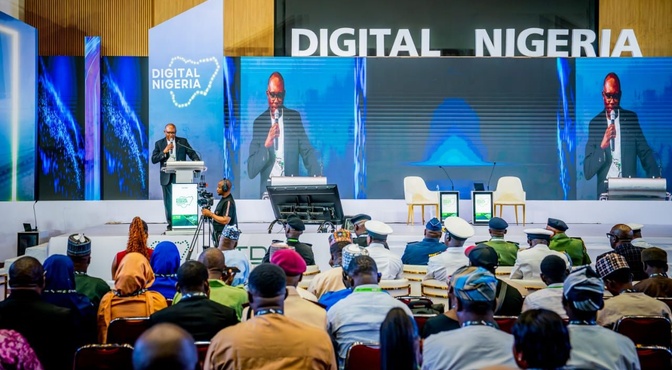
*Kashifu Inuwa Abdullahi, CCIE, Director-General, National Information Technology Development Agency, outlines the broader vision driving Nigeria’s digital future, urging young technology entrepreneurs to focus on solving economic and societal challenges through technology
Isola Moses | ConsumerConnect
Engr. Olusola Obadimu, Director-General of the Nigerian Association of Chambers of Commerce, Industry, Mines and Agriculture (NACCIMA), has said Nigeria’s ambition of building a $1 trillion economy by 2030 will depend on the country’s ability to transform digital innovation into productivity, industrial growth, investment and jobs.
Obadimu stated this while delivering a keynote address at the Digital Nigeria International Conference and Exhibition (DNICE) 2026, held at the President Bola Ahmed Tinubu International Conference Centre, in Abuja, FCT.
Nexus between technology and productivity, industrialisation, growth
The Director-General of NACCIMA also challenged stakeholders to move beyond conversations about technology and focus on converting innovation into measurable economic outcomes in Nigeria.
He noted that the debate regarding whether digital technology would transform Nigeria’s economy is over.
The pressing challenge, Engr. Obadimu stated, is ensuring that technology is deliberately linked to productivity, industrialisation, export growth, job creation and national prosperity.
He further said: “We are no longer debating whether digital technology will transform our economy. It already is.
“The question is whether Nigeria will merely consume that transformation or deliberately connect it to productivity, industrialisation, jobs, exports and national growth.”
The Director-General of NACCIMA noted that achieving President Bola Ahmed Tinubu’s vision of a $1 trillion economy would require stronger alignment between technology, enterprise and investment.
He equally emphasised that sustainable growth would be driven by productive businesses operating in agriculture, manufacturing, mining, trade and services rather than government intervention alone.
Obadimu further explained: “The road to a one-trillion-dollar economy runs through productivity. That economy will not be built in government offices.
“It will be built on farms, in factories, in laboratories and through businesses that create value every day.”
The NACCIMA Chief identified Micro, Small and Medium Enterprises (MSMEs) as critical to the country’s economic transformation.
He also argued that digital policies would have limited impact unless they directly improve the productivity and competitiveness of small businesses.
Inuwa speaks on Nigeria’s digital future and NACCIMA, NITDA partnership
Engr. Obadimu highlighted the growing partnership between NACCIMA and the National Information Technology Development Agency (NITDA).
He described the two organisations’ collaboration as a strategic effort aimed at bridging the gap between innovation and commercialisation.
While NACCIMA focused attention on the economic dividends of digital innovation, Malam Kashifu Inuwa Abdullahi, CCIE, Director-General of NITDA, outlined the broader vision driving Nigeria’s digital future.
Represented at the event by Dr. Aristotle Onumo, Director of the Special Duties Directorate at NITDA, the Director-General of the country’s IT sector regulator, urged stronger collaboration among government institutions, industry players, academia, development partners and innovators to accelerate Nigeria’s transition into a thriving digital economy.
Inuwa also described digital economy as a strategic driver of national development, innovation and competitiveness, noting that emerging technologies are reshaping businesses, industries and societies around the globe.
The NITDA Chief stated: “We are not here merely to discuss the future; we are here to build it. Digital Nigeria is designed to move beyond conversations to implementation, collaboration and measurable impact.”
According to him, Nigeria possesses the talent, entrepreneurial spirit and innovative capacity needed to become a leading digital economy, but success would require deliberate investments in skills development, entrepreneurship, innovation, infrastructure and strategic partnerships.
Inuwa further explained that the 2026 conference was built around four strategic pillars focused on identifying the people who will build Nigeria’s digital future, determining how that future will be built, equipping citizens with the skills required to thrive in the digital economy, and recognising individuals and organisations driving excellence across the ecosystem.
On Builders Festival initiative
In his remarks also, Dr. Onumo emphasised that no single institution could build Nigeria’s digital future alone.
He stressed that government must work with industry, academia, innovators and development partners to unlock the full potential of the digital economy.
An initiative designed to translate that vision into practical outcomes is the Builders Festival, which emerged as one of the defining highlights of the conference.
The agency also disclosed that insights shared by Glory Olamigoke and David Ogobe showed how the initiative is helping to redefine innovation support in Nigeria by shifting the conversation from ideas to solutions and from potential to impact.
According to them, Nigeria’s technology ecosystem has recorded remarkable growth over the past decade, driven largely by software developers, entrepreneurs and technology professionals whose innovations have transformed sectors such as financial technology, digital payments, mobility and digital commerce.
The duo noted that the next phase of growth would depend on nurturing a new generation of “builders” capable of creating products and businesses that solve real-world problems.
Unlike conventional technology conferences, the Builders Festival began by identifying challenges rather than showcasing solutions.
Companies and institutions were invited to submit operational and industry-specific problems requiring innovative interventions.
Following extensive review, organisers of the forum identified 21 priority challenges and opened them to startups, developers, founders and innovators across Nigeria.
According to them response was overwhelming.
NITDA revealed that over 1,500 innovators submitted applications, highlighting both the depth of creativity within Nigeria’s innovation ecosystem and the growing determination of young Nigerians to solve economic and societal challenges through technology.
According to the agency, following a rigorous selection process, thirty finalists emerged and developed prototypes that were presented before investors, industry leaders and judges.
The eventual winner received a $50,000 equity-free grant alongside mentorship and institutional support, while other outstanding innovators secured grants ranging from $10,000 to $30,000.
Beyond the financial rewards, participants gained access to business development networks, investors, regulators, industry experts and strategic opportunities capable of helping them scale their innovations into commercially viable enterprises.
For Olamigoke and Ogobe, the significance of the initiative lies not in the prize money but in its ability to bridge one of the greatest challenges confronting African innovation: connecting talent with opportunity.
The stakeholders in attendance also contended that as Nigeria has no shortage of brilliant young innovators, many lack access to funding, mentorship, business infrastructure, networks and market opportunities required to transform ideas into sustainable businesses.
That thinking aligns with Obadimu’s call for innovation to be tied directly to productivity and commercial outcomes, while reinforcing NITDA’s vision of building a technology ecosystem where innovation is not merely celebrated but deployed to solve problems and create economic value.
Beyond innovation and economic growth, stakeholders repeatedly stressed that the future digital economy must be secure, trusted and inclusive.
Adoption of adoption of Artificial Intelligence and other emerging techs
Delivering a goodwill message on behalf of the Chief of Army Staff (COAS), Waheed Shuaibu, the Commander of the Nigerian Army Cyber Warfare Command, Major-General E. S. Mustapha warned that the increasing adoption of Artificial Intelligence (AI) and other emerging technologies has heightened cybersecurity risks, and created new challenges for national security.
He described cybersecurity and digital resilience as strategic national priorities and called for stronger collaboration, capacity building and investment in digital skills to safeguard Nigeria’s digital future.
Similarly, the Inspector-General of Police, IGP Tunji Disu, represented by a Commissioner of Police, Ayodele Oluyemi, underscored the growing role of technology in intelligence-led and citizen-focused policing.
The Police chief noted that artificial intelligence, data analytics, digital forensics and secure communication systems are increasingly shaping modern policing and stressed the need for stronger partnerships to address emerging security threats in the digital age.
While security remained a major focus, trust emerged as another recurring theme throughout the conference.
Dr. Vincent Olatunji, National Commissioner and Chief Executive Officer (CEO) of the Nigeria Data Protection Commission (NDPC), represented by the Head, Innovation Department, Ms. Adaobi Nwankwo reiterated the Commission’s commitment to data privacy, responsible data governance and digital trust.
According to Olatunji, public confidence remains fundamental to the success of digital transformation, particularly as governments, businesses and citizens increasingly rely on digital platforms and services.
He emphasised the need for stronger collaboration among stakeholders to ensure that innovation flourishes within a secure environment that protects citizens’ rights and personal data.
Speaking on behalf of the Federal Character Commission (FCC), Mr. Paul Apiade stressed that digital transformation must expand opportunities rather than create new forms of exclusion.
Apiade noted that technology has become indispensable to improving governance, enhancing transparency and strengthening public service delivery.
He urged stakeholders to ensure that all Nigerians, regardless of geography, gender, social status or background, benefit from the opportunities created by the digital economy.
Apiade also acknowledged NITDA’s support in strengthening digital capacity across government institutions and identified cybersecurity, data protection and digital trust as critical pillars of an inclusive digital future.
As discussions, exhibitions, masterclasses and innovation showcases continued throughout the conference, a clear consensus emerged among participants.
Nigeria possesses the market, the talent, the entrepreneurial energy, the innovation ecosystem and the ambition required to become one of Africa’s leading digital economies.
What remains, stakeholders agreed, is to deliberately connect innovation to industry, startups to customers, skills to jobs, ideas to investment and policy to implementation.
For many participants, the true measure of Digital Nigeria 2026 will not lie in the speeches delivered from the conference podium but in the businesses created, technologies commercialised, investments secured, jobs generated and lives transformed after the event.