


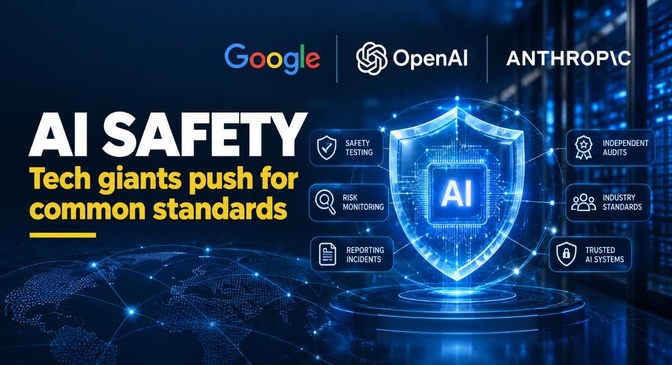
*Global Artificial Intelligence industry stakeholders converge on Paris, French capital, to sign a safety and security pact on frontier AI models, stating the declaration remains open to new endorsements, as developers have committed to working on a clear governance structure with defined responsibilities, adequate resources, and independent oversight in the global digital ecosystem
Gbenga Kayode | ConsumerConnect
In a strategic move to build advanced Artificial Intelligence (AI) that is safe, secure, useful, and widely available to all humans, scores of Heads of States and Governments, as well as Chief Executive Officers (CEOs) of leading AI companies and Civil Society Organisations (CSOs), Monday, November 9, 2026, signed an AI safety and security pact, in Paris, French capital.
ConsumerConnect reports the following Heads of States and Governments, CEOs and CSOs’ representatives inked the declaration Monday.
GTBank customer alleges N2.59m theft from 2 accounts, laments ‘no customer’s funds are safe’
These included Heads of States and Governments from Bahrain, Canada, Finland, France, Norway, The Netherlands.
The CEOs of AI companies, including Anthropic, Black Forest Labs, Cohere, Domyn, Hugging Face, Microsoft, Mistral AI, OpenAI, Sakana AI and Synthesia also endorsed the declaration.
Representatives of the civil society, such as LawZero (Yoshua Bengio), SaferAI (Henry Papadatos), AI Safety Connect (Nicolas Miailhe), Ifri (Laure de Roucy-Rochegonde) as well signed the pact in Paris, agency report said.
Stakeholders disclosed the new-fangled pact yet remains open to new endorsements, as it is being updated.
They also stated in the declaration: “We reaffirm our shared interest and common responsibility in building advanced Artificial Intelligence that is safe, secure, useful, and widely available to all.
“The responsible development of these technologies and the adoption of reliable AI systems represent unprecedented drivers of economic, scientific, and social progress for our nations.”
AI safety, a collective responsibility to protect citizens, businesses and institutions worldwide
The stakeholders declared: “Our ambition is to lay the necessary foundations for safe adoption.
“Frontier models transcend national borders in their development, deployment and impact, and their opportunities and risks are therefore inherently global.”
The statement noted: “We all have a role in protecting our societies while enabling research, innovation and the wider use of AI.
“It is our collective responsibility to protect citizens, businesses and institutions, while also fostering an environment conducive to research, innovation, and the widespread adoption of these technologies.”
The pact further stated: “No actor, be it a State, a company or an international organisation, can solely manage all these risks.
“In this regard, continuing efforts from policymakers, researchers, and AI companies have laid the groundwork for concrete cooperation for taking actions, including through the Hiroshima process, the Frontier Safety Commitments of the Seoul AI Summit, the G7 Evian AI meeting, the United Nations Security Council meeting on AI held on 23 September and the ‘Call for Control of Frontier AI Models’.”
3 Fundamental areas of consensus in Paris
The stakeholders affirmed that Monday’s discussions highlighted three fundamental areas of consensus: the need for a clear, understandable, and predictable regulatory framework; the urgency of achieving tangible and immediate results in transparency, incident reporting and risk management; and the absolute necessity of implementing rigorous evaluation standards.
They noted: “This declaration reflects our commitment to making a substantial contribution and accelerating the implementation of these priorities.
“To operationalise this shared vision, we commit today to establishing a structured framework for cooperation, based on three major strategic commitments:
“First, policy makers, researchers and developers are committed to establishing a common framework for the evaluation and risk management of frontier models, building on existing frameworks.”
The stakeholders said: “This framework would be supported by common technical standards, evaluation tools and methodologies that keep pace with advances in frontier model capabilities, with particular focus on mitigating dangerous misuse, including in the cyber and CBRN domains, and risks arising from growing autonomy or model misalignment, including loss of control.
“In this regard, we are committed to reinforcing technical cooperation, and recognise the role that existing networks, including International Network for Advanced AI Measurement, Evaluation and Science (NAAIMES) can play in making evaluation methods and results more comparable and accessible to countries across different regions.”
The participants stated: “Furthermore, we agree to publish the non-sensitive findings of our evaluations in a standardised format to ensure comparability, while also creating a publicly accessible shared repository.
“This could encompass red-teaming protocols, benchmarking tools, risk-assessment, stress-test results.”
They stated: “Second, we affirm the principle of responsibility and accountability for all actors in the AI ecosystem, based on their role in this ecosystem.
“We commit to ensure strict compliance with rigorous safety standards established or recognised by competent national authorities across the model lifecycle, under the oversight of those authorities and with credible, competent and independent third-party evaluation in order to foster the necessary trust among all stakeholders and enable wider adoption of AI.”
The stakeholders said: “Clear incentives can be used to encourage prioritisation of safety and security from the design phase throughout the lifecycle;
“Policy makers: Recognise the need to ensure that legal frameworks clarify responsibilities and accountability in case of large-scale damages to protect the interests of those affected, including where harm crosses borders in order to provide AI companies with legal certainty for their economic development.
On developers’ commitment to supporting frontier AI models
For developers of frontier AI models present at the forum in Paris, the declaration noted that they “commit to disclose model capabilities, limitations, and known risks and, where appropriate and proportionate to the risk, support the evaluation of models by qualified independent evaluators, as appropriate and consistent with existing practices and arrangements.
The pact revealed the developers also committed to implementing fail-safe mechanisms to shut down model operations within their control, including during training and internal use (e.g. restrictions, pauses or shutdowns);
Acknowledge the risk posed by the removal or circumvention of safeguards, including abliteration, and the importance of addressing that risk while preserving the benefits of open-weight development for research, innovation and safety purposes;
Recognise the importance that internal governance must mandate continuous risk management practices, real-time monitoring of emergent capabilities, rigorous internal red-teaming, and transparent reporting lines that protect internal researchers.
Besides, the developers are committed to working on a clear governance structure with defined responsibilities, adequate resources and independent oversight.
Third, policy makers, researchers and developers are equally committed to information sharing, reporting and early warning systems.
The declaration as well indicated the deployment of rapid alert systems, building on relevant existing incident-response arrangements, including cybersecurity arrangements, is essential to prevent cascading systemic risks, and to formulate collective responses to emerging threats, so as to support their timely resolution and limit their consequences and real-world impacts.
The pact stated: “We recognise the value of strengthening existing reporting arrangements to align on incident classification and share timely information on serious cyber and AI control incidents and other material precursor signals of serious harm, whether it’s between companies and government, between governments or between AI companies, and of exploring whether a cooperation mechanism would help, and what its scope could be.
“Policy makers commit to offer secure and confidential channels through which whistleblowers, including employees and other relevant stakeholders, can raise concerns about systemic risks on reasonable grounds without fear of legal or professional retaliation.”
Pingback:2027: INEC urges election petition tribunals to shun technicalities, allow ‘truth of the ballot prevail’ - Consumer Experience Is A Top Priority
Pingback:Oyo 2027: Ogunwuyi, Agbeti lead Chairmen of 3 LG Councils, 29 other appointees join APC - Consumer Experience Is A Top Priority
Pingback:Infractions: INEC removes 1.6m records from voter register as 54 personnel face sanction in 10 states - Consumer Experience Is A Top Priority
Pingback:Fuel Hikes: Nigeria monitoring local PMS pump prices amid falling crude price –FCCPC - Consumer Experience Is A Top Priority
Pingback:Northern leaders’ strategic support for President Tinubu, by Kemi Yesufu - Consumer Experience Is A Top Priority
Pingback:GTBank customer alleges N2.59m theft from 2 accounts, laments ‘no customer’s funds are safe’ - Consumer Experience Is A Top Priority
Pingback:Open FirstBank account digitally, anytime and anywhere - Consumer Experience Is A Top Priority