


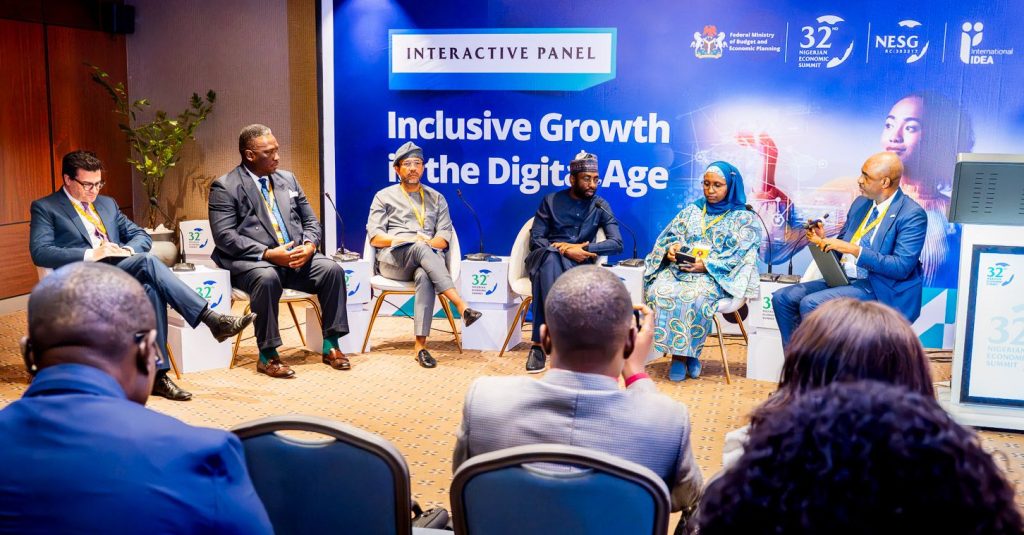
*Kashifu Inuwa Abdullahi, CCIE, Director-General, emphasises the need for inclusive digital infrastructure, affordable connectivity and sustained investment in emerging technologies, highlighting how the move will accelerate Nigeria’s economic growth while ensuring no citizen is left behind in the digital economy
Isola Moses | ConsumerConnect
The National Information Technology Development Agency (NITDA) has emphasised the need for inclusive digital infrastructure, affordable connectivity and sustained investment in emerging technologies in Nigeria.
NITDA said the move would accelerate the country’s economic growth, and ensure that no citizen is left behind in the emerging Nigeria Digital Economy.
ONSA, NCC, NITDA, others advocate collaboration, cyber resilience over AI-generated attacks
Malam Kashifu Inuwa Abdullahi, CCIE, Director-General of the agency, stated this while participating in a session titled: “Inclusive Growth in the Digital Age” at the 32nd Nigerian Economic Summit (NES#32).
ConsumerConnect reports the Federal Ministry of Budget and Economic Planning organised the Summit, where Inuwa highlighted the significance of expanding telecoms infrastructure, particularly to underserved and rural communities.
The Director-General also noted that Africa’s telecoms history has demonstrated how innovation can overcome seemingly insurmountable barriers to development.
Reflecting on the growth of the telecoms sector since 2000, the NITDA Chief Executive recalled that several investors were initially reluctant to commit resources to the industry because of doubts about Africans’ ability to afford mobile phones.
Inuwa said innovative approaches to infrastructure development and service delivery, however, had helped to transform the sector despite inadequate electricity, roads and other essential infrastructure.
According to him, innovation must focus on democratising access, reducing costs and extending connectivity to rural communities to ensure that every citizen can participate meaningfully in the digital economy.
Inuwa further stressed that connectivity has become fundamental to social and economic inclusion, particularly as Artificial Intelligence (AI) increasingly shapes decision-making and service delivery worldwide.
He stated: “If you are not represented, if you are not digitally visible, AI will not see you or consider you when making decisions.”
The Chief Executive of the IT sector regulatory agency emphasised that the exclusion of communities from the digital ecosystem could also mean the underrepresentation of their cultures, values and languages in emerging technologies.
The Federal Government under President Bola Ahmed Tinubu’s leadership is committed to using technology to promote inclusivity and national prosperity, Inuwa intoned.
He further said Tinubu had directed Dr. ‘Bosun Tijani, Honourable Minister for Communications, Innovation and Digital Economy (FMCIDE), to conceptualise two major initiatives aimed at expanding connectivity across the country: the Universal Service Provision Fund (USPF) project and Project BRIDGE.
Inuwa explained the USPF initiative was designed to extend telecoms coverage to underserved areas through the deployment of base stations, while Project BRIDGE aims to deploy approximately 95,000 kilometres of fibre-optic infrastructure nationwide.
He assured Nigerians that the digital initiatives would promote open-access infrastructure, encourage private-sector participation and make broadband services more affordable for Nigerians.
The Director-General of NITDA urged a broader understanding of infrastructure development.
He argued the digital economy requires investments beyond conventional infrastructure, such as roads and railways.
Inuwa averred: “Today, we are in a digital era; therefore, we need to build digital highways for our data as well.”
As Nigeria advances its Artificial Intelligence ambitions, investments in data centres, computing capacity and AI factories will be essential to ensuring the West African country can harness the technology’s economic potential, said Inuwa.
Besides, he highlighted the relationship between connectivity, productivity and affordability, describing it as a chicken-and-egg situation. He explained that while telecoms operators are concerned about consumers’ ability to pay for services, improved connectivity can enhance productivity, expand business opportunities and increase incomes, thereby strengthening citizens’ capacity to afford digital services.
The Director-General emphasised the need to connect underserved communities, so that individuals and businesses could use technology to improve their livelihoods, access new markets and participate more effectively in economic activities.
Beyond economic benefits, Inuwa said expanded digital infrastructure would enable the government to improve public service delivery and reduce operational costs by making essential services more accessible online.
He explained that citizens interact with government institutions at different stages of their lives, from birth registration and healthcare to education, employment, business development, marriage and property ownership.
However, the traditional process often requires citizens to visit multiple government offices to access these services.
According to him, a well-developed digital infrastructure would enable citizens to access government services more conveniently, improve service delivery and reduce administrative overheads.
Inuwa insisted that bridging Nigeria’s digital divide would require a coordinated action by government and the private sector, supported by sustained investment in connectivity and advanced digital infrastructure.
The Director-General restated that inclusive digital development remains essential to ensuring that all Nigerians can benefit from technological innovation, contribute to national productivity and participate in the country’s emerging digital economy.