


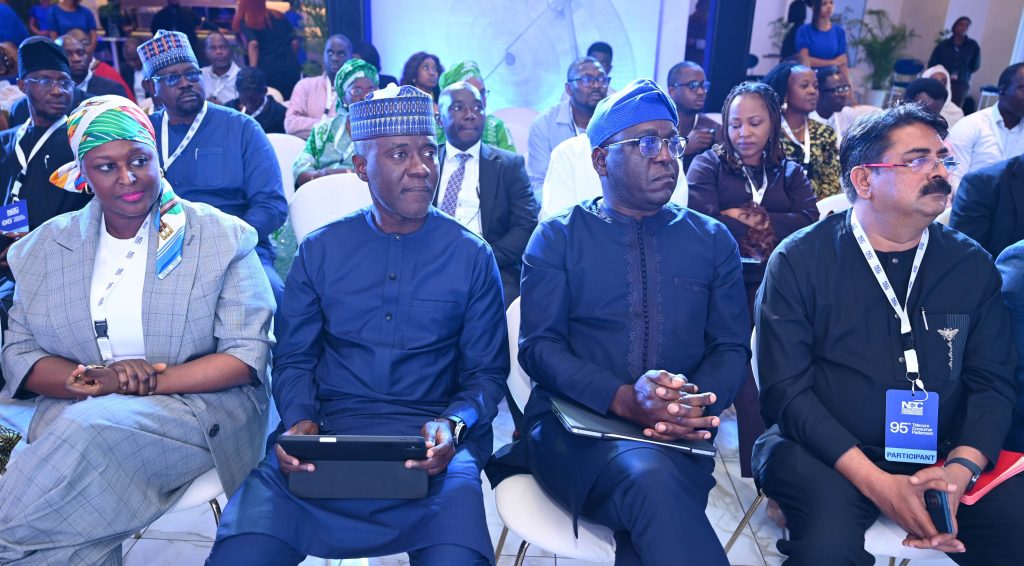
*Dr. Aminu Maida, Executive Vice-Chairman and CEO, Nigerian Communications Commission, at the 95th Telecom Consumer Parliament, in Lagos, insists telecoms consumers deserve reliable connectivity, transparent billing, and accessible avenues for redress whenever service expectations are not met
Gbenga Kayode | ConsumerConnect
The Nigerian Communications Commission (NCC) has reiterated its commitment to protecting telecoms consumers in the West African country.
The NCC assurance is in line with its consumer-centric leadership approach as the Commission intensifies regulatory measures to improve consumer experience in the telecoms ecosystem.
NITDA boosts digital public services as government MDAs begin IPv6 migration training
ConsumerConnect reports the industry regulator declared that Mobile Network Operators (MNOs) would be held accountable for service failures cum poor Quality of Service (QoS) henceforth.
Maida speaks on theme of 95th TCP
Dr. Aminu Maida, Executive Vice-Chairman and Chief Executive Officer (EVC/CEO) of NCC, said this at the 95th Telecom Consumer Parliament (TCP), in Lagos.
The theme of the TCP was: “Enhancing Consumer Experience: Strengthening Service Quality and Consumer Protection in Nigeria’s Digital Economy”.
Media emphasised that effective regulation must translate into tangible improvements in consumers’ daily experiences in the telecoms space.
Emphasis on consumer-centric regulatory approach in telecoms
The EVC/CEO of the telecoms regulatory Commission also noted that NCC remains focused on enforcing service standards, protecting consumer rights while ensuring that telecoms operators deliver the promised QoS to subscribers.
Telecoms consumers, the Executive Vice-Chairman stated, deserve reliable connectivity, transparent billing, and accessible avenues for redress whenever service expectations are not met.
Maida further averred that as the industry regulator, the Commission has an obligation to protect consumers by setting clear standards, holding service providers accountable, and ensuring that there is a fair way to seek redress.
He said: “We must judge our work by the difference it makes to your experience.
“For a trader waiting to confirm a customer’s payment, a network failure can mean a lost sale, while a student trying to submit an assignment can miss a deadline because of a slow connection.”
The Chief Executive of NCC equally noted: “These everyday experiences should guide our conversation today (Tuesday), because people want their phones to work, their charges to make sense, and someone to take responsibility when things go wrong.”
Speaking on the theme of the 95th Telecom Consumer Parliament, Maida said: “Our theme, ‘Enhancing Consumer Experience: Strengthening Service Quality and Consumer Protection in Nigeria’s Digital Economy’, speaks directly to our responsibility.”
Review of service providers’ responsibility to improved service quality
Highlighting ongoing efforts at improving network performance, he revealed that network operators had undertaken over 6,500 network improvement interventions in 2026 alone.
According to the NCC Chief, these include capacity expansions, equipment upgrades, and deployments of newer technologies aimed at delivering more reliable voice and data services to Nigerian telecoms consumers.
As part of the NCC consumer education and sensitisation initiatives, Maida urged consumers to leverage the Commission’s public coverage maps and performance-monitoring tools available on the NCC official Web site to make informed choices about network providers in their respective locations across the country.
He explained: “Our public coverage maps on the NCC Web site provide an independent comparison of networks using crowdsourced performance data from people’s everyday experience.
“You can use them to compare coverage and performance where you live, work or run your business, and see which network may best meet your needs.”
CNII and protection of critical telecoms assets
The country’s chief telecoms regulator, however, expressed concern over the persistent vandalism of telecoms infrastructure in view of the Federal Government’s classification of telecoms assets as the Critical National Information Infrastructure (CNII).
Maida observed that fibre cuts, theft of equipment, and damage to network facilities have continued to disrupt services and negatively impact consumers and businesses in the Nigerian economy.
The EVC/CEO of the Commission stressed that protecting telecoms infrastructure remains critical to sustaining service availability across the West African country.
Restating the Commission’s avowed consumer-centred regulatory approach, Dr. Maida disclosed that approximately 75 million subscribers have benefited from airtime compensation under the NCC’s Consumer Compensation Framework this year.
The Commission will continue to enforce compliance and sanction breaches where necessary to safeguard consumer interests, said he.
The Executive Vice-Chairman averred: “We will continue to hold operators accountable for the quality of service they provide.”
Core objectives of Telecom Consumer Parliament, by ECSM Makama
Earlier in her welcome remarks at the event, Ms. Rimini Makama, Executive Commissioner Stakeholders Management (ECSM) at NCC, told the gathering that the 95th Edition of the Parliament was designed to deepen conversations around service reliability, billing transparency, and effective consumer complaint resolution.
Makama urged stronger collaboration among regulators, operators, consumer groups, and other stakeholders to build a telecoms ecosystem that consistently delivers value and confidence to Nigerian consumers.
She also stated: “When you pay for a service, you should be able to depend on it, while the second is Clear Billing, No Surprises.
“You should be able to understand your data usage, your charges and any Value-Added Services on your line, without confusion or unexpected deductions, and the third is Every Voice Heard, No One Ignored.”
The ECSM noted: “When you raise a complaint, you deserve to be listened to, treated fairly and helped in good time.
“That includes consumers who may face additional barriers in accessing services.”
Pingback:2027 Elections: INEC reviews CVR records, PVC bottlenecks in South-East Nigeria - Consumer Experience Is A Top Priority
Pingback:FirstBank committed to 65-year Lagos Amateur Open Golf - Consumer Experience Is A Top Priority
Pingback:NITDA unveils National Digital Literacy Dashboard, trains 2.77m Nigerians in digital skills - Consumer Experience Is A Top Priority