


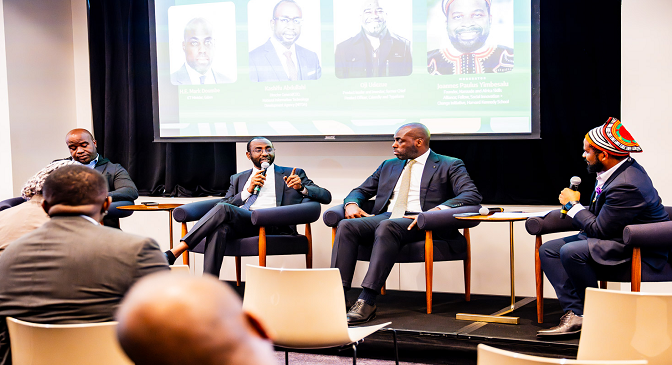
*Kashifu Inuwa Abdullahi, CCIE, Director-General/CEO, National Information Technology Development Agency, tasks global policymakers and ecosystem leaders to go beyond counting the number of people trained, and focus on whether digital skills are being converted into productive work, enterprise and improved livelihoods worldwide
Isola Moses | ConsumerConnect
Malam Kashifu Inuwa Abdullahi, CCIE, Director-General/Chief Executive Officer (CEO) of the National Information Technology Development Agency (NITDA), has challenged global policymakers and ecosystem leaders to move beyond counting the number of people trained, and focus instead on whether digital skills are being converted into productive work, enterprise and improved livelihoods worldwide.
ConsumerConnect reports Inuwa stated this during a conversation on the sidelines of the 81st Session of the United Nations General Assembly (UNGA), in New York, United States (UN).
InFocus: UN Security Council and Big Techs’ concerns about risks of ‘uncontrollable AI’
NITDA affirmed the Director-General participated in the high-level panel session, “Scaling Africa’s Digital Workforce”, under the Digital Skills and Talent Session of “Nigeria at Scale: Building Digital Systems for Shared Prosperity,” at the global event in the US.
The Director-General of the agency had joined H.E. Mark Doumba, ICT Minister of Gabon, and Oji Udezue, Product Leader and Investor, former Chief Product Officer at Calendly and Typeform.
Industrialised training without industrialising the transition?
Joannes Paulus Yimbesalu, Founder, Nanaade and Africa Skills Alliance; Fellow, Social Innovation + Change Initiative, Harvard Kennedy School, moderated the conversation.
Inuwa stated: “We have industrialised training; we have not yet industrialised the transition.”
He also identified three critical barriers confronting young people as they move from training to work: the trust gate, where employers struggle to verify capabilities; the platform and connectivity gate, where lack of devices, affordable connectivity, reliable power and access to opportunity limits participation.
He equally noted the demand gate, where the number of people entering the labour market significantly exceeds available formal jobs.
On Nigeria’s digital transformation agenda
Highlighting Nigeria’s response, the NITDA Chief explained Nigeria’s IT sector regulatory agency and the Federal Ministry of Communications, Innovation and Digital Economy (FMCIDE) are deliberately connecting digital literacy, advanced technical skills, connectivity, cloud infrastructure, and job creation as parts of one digital transformation agenda.
The Director-General particularly referenced the 3 Million Technical Talent (3MTT) programme, which has trained over 143,000 Fellows across three cohorts, alongside the Talent Registry designed to connect verified skills with employers.
Expatiating further on the country’s digital transformation agenda, Inuwa highlighted Project BRIDGE, envisioned to deploy at least 90,000 kilometres of open-access fibre and extend Nigeria’s national backbone to about 125,000 kilometres, reaching all 774 Local Government Areas (LGAs).
The initiative is expected to expand connectivity to thousands of schools, healthcare facilities and local government offices.
According to him, this will help to ensure that talent developed outside major cities can participate in the digital economy.
It is noted that a central message of the NITDA Chief Executive intervention was: digital literacy and digital employability are related but distinct objectives.
The agency stated that through NITDA’s Strategic Roadmap and Action Plan (SRAP 2.0), basic digital literacy is designed to give every Nigerian the foundational capabilities to participate safely and confidently in the digital economy, while advanced programmes, such as 3MTT prepare young Nigerians for opportunities in AI and Machine Learning, data science, software development, cloud computing and cybersecurity.
Essence of digital inclusion in digital workforce strategy, by Inuwa
Africa’s digital workforce strategy cannot be built solely around formal employment, stated he.
Inuwa said, however, digital inclusion must encompass traders, artisans, farmers, mechanics, transport operators, food vendors and other entrepreneurs whose livelihoods can be transformed through technology.
For these Nigerians, he explained, digital skills should translate into practical capabilities: using smartphones productively, accepting digital payments, marketing through social media, finding customers and suppliers, maintaining digital records, protecting themselves from fraud, accessing digital services and using AI tools to increase productivity.
The CEO also said: “The question is not, ‘Can this person get a technology job?’ It is, ‘Can technology help this person earn more, reduce costs, reach more customers and run a better business?’ ”
Re-emphasising the need to redirect greater attention towards the critical bridge between learning and earning, he averred: “Fund the corridor, not another classroom, verifiable credentials and first-paid-work placement, because Africa’s young people are stuck in the gap between the certificate and the paycheck.”
NITDA, therefore, affirmed that the measure of success is not simply how many Nigerians are trained, but how many could translate digital capability into jobs, enterprise, higher productivity, greater income, and meaningful participation in the burgeoning Nigeria Digital Economy.