


*The Independent National Electoral Commission, in Nigeria again, raises concerns over the growing threat the Generative Artificial Intelligence poses to the credibility of elections, warning the misuse of AI tools in producing manipulated content, and highly targeted messaging designed to feed conflicting narratives to different groups of voters is real in the country
Alexander Davis | ConsumerConnect
The Independent National Electoral Commission (INEC) again, has raised concerns over the growing threat the generative Artificial Intelligence (AI) poses to the credibility of elections in Nigeria.
INEC warned that the misuse of AI tools in producing manipulated audio, video and images, as well as highly targeted messaging designed to feed conflicting narratives to different groups of voters, is “no longer a distant, theoretical risk” to the Commission.
Energy: Nigerian Government reassures consumers no plan to raise electricity tariffs
INEC reiterated the Commission earlier had raised same concerns on previous occasions.
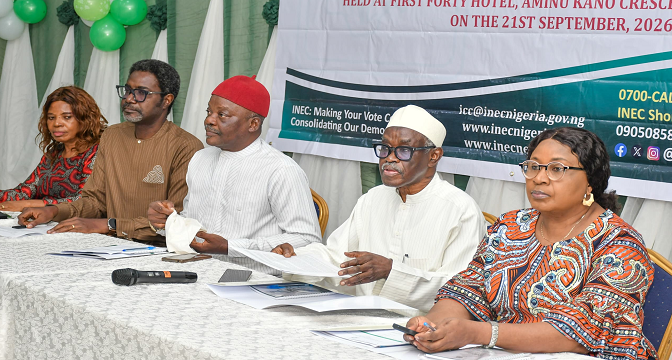
Malam Mohammed Kudu Haruna, National Commissioner and Chairman of the Information and Voter Education Committee (IVEC), Monday, September 21, 2026, in Abuja, FCT, noted this development as he declared open a Capacity Building Workshop for Public Affairs Officers (PAOs) drawn from across the states of the Federation.
Haruna said Generative AI “has made it cheaper, and considerably harder to detect manipulated audio, video and images.”
He also noted that its misuse extends beyond fabricated content to targeted messaging capable of dividing voters along conflicting narratives.
The National Commissioner and Chairman of the Information and Voter Education Committee also recalled that Prof. Amupitan, speaking recently at the 13th Annual International Conference of the Association of Communication Scholars and Professionals of Nigeria, had stated that “election credibility today no longer depends only on ballot papers, BVAS machines and result sheets.”
Amupitan said it also “depends equally on the information environment in which voters form their judgments.”
The Chairman of INEC advocated electoral technology and electoral communication to be treated “not as separate concerns but as a single discipline.”
Training of Public Affairs Officers as frontline communicators
National Commissioner Haruna described the workshop with the theme, “Strengthening PAOs Capacity for Credible, Verified and Responsible Election Communication Towards 2027”, as a direct response to this reality.
He said Public Affairs Officers were “the frontline communicators of INEC in the states”.
He further said that “the credibility of INEC’s communication, in many respects, begins with the work you do.”
According to him, the skills to be built at the workshop, “in verification, in escalation, and in clear, consistent messaging,” would be tested in real time as the 2027 General Elections approach.
Haruna commended the Voter Education and Publicity (VEP) Department for designing a programme that is “practical, skills-based, and directly relevant to the realities you face at the state level.”
Earlier, in her welcome remarks, Mrs. Victoria Eta-Messi, Director of Voter Education and Publicity, had told participants that “it is through you that Nigerians form much of their impression of who we are, what we stand for, and how reliable our information is.”
Mrs. Eta-Messi said INEC “operates under constant public scrutiny, and is regularly confronted with attempts to misrepresent its work and undermine public confidence in it.”
She also disclosed that the workshop was not a one-off engagement, noting that further capacity-building interventions were “at advanced stages of planning, with development partner support.”
The Director of Voter Education and Publicity at INEC described the training as “the beginning of sustained engagement to ensure you are well prepared for your assigned responsibility.”
Presenting the objectives of the workshop, Mr. Wilfred Ifogah, Deputy Director, Information and Publicity at INEC, said the training was designed “to strengthen the practical communication skills that Public Affairs Officers require in their day-to-day work, both now and as we approach the 2027 General Elections.”
Ifogah listed the objectives to include clarifying escalation lines between PAOs, Heads of Department, Voter Education and Publicity, and Resident Electoral Commissioners (RECs); strengthening consistent writing across press statements, talking points and social media platforms; building capacity to monitor the information ecosystem and respond to misinformation and disinformation; and introducing “the responsible use of artificial intelligence in communication work, including its practical applications, its limitations, and the safeguards required around confidentiality and verification.”
He also said participants were expected to leave the workshop with “a shared appreciation of the standards of accuracy, consistency and professionalism required of every Public Affairs Officer of this Commission,” particularly ahead of the 2027 General Elections.