


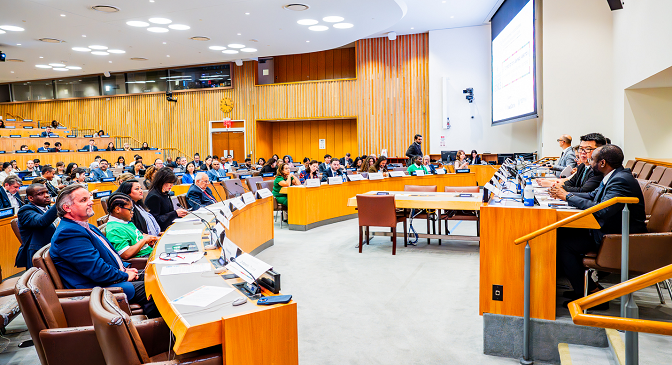
*Kashifu Inuwa Abdullahi, CCIE, Director-General, Nigeria’s National Information Technology Development Agency, reminds global leaders at the high-level opening session of the 81st Session of the United Nations General Assembly, in New York, that a truly inclusive Artificial Intelligence must empower citizens, reflect the data, languages, cultures, contexts and values of the digital consumers it is designed to serve for sustainable development of humanity
Gbenga Kayode | ConsumerConnect
As conversations on Artificial Intelligence (AI) for inclusive human development gain traction worldwide, Malam Kashifu Inuwa Abdullahi, CCIE, Director-General/Chief Executive Officer (CEO) of the National Information Technology Development Agency (NITDA), has joined distinguished global leaders and development champions in a high-level dialogue, focused on leveraging technology, innovation and social business, to advance sustainable and inclusive development.
ConsumerConnect reports NITDA affirmed the high-level opening session at the UN Headquarters, in New York, United States (US), featured H.E. Dr. Khalilur Rahman, President of the 81st Session of the United Nations General Assembly (UNGA), and H.E. José Ramos-Horta, President of the Democratic Republic of Timor-Leste and 1996 Nobel Peace Laureate.
Energy: Nigerian Government reassures consumers no plan to raise electricity tariffs
Other high-profile personalities that graced the opening session are H.E. Dasho Tshering Tobgay, Prime Minister of the Kingdom of Bhutan; H.E. Wellington Dias, Brazil’s State Minister of Development and Social Assistance, Family and Fight Against Hunger; and H.E. Bilal Bin Saqib, MBE, Minister of State and Chairman of Pakistan’s Virtual Assets Regulatory Authority.
The programme also featured Prof. Muhammad Yunus, 2006 Nobel Peace Laureate, Founder of Grameen Bank and Chair of the Global Committee on Social Business for Sustainable Development Goals (SDGs).
The Nigerian IT sector regulatory agency also disclosed Ms. Lamiya Morshed, Executive Director of the Yunus Centre, introduced the session while Mr. Dominique V. Dauster, Managing Director, Yunus+You – YY Foundation, and Mr. James Chau, President of the China-United States Exchange Foundation and WHO Goodwill Ambassador, co-moderated the forum.
What a truly inclusive AI is, by Inuwa, NITDA Chief
In his keynote, Inuwa, Director-General/CEO of NITDA, challenged the global community to look beyond simply expanding access to Artificial Intelligence, but focus on building an AI future, founded on Representation, Access and Agency respectively.
He also contended that truly inclusive AI must reflect the data, languages, cultures, contexts and values of the digital consumers it is designed to serve.
Inuwa maintained that such inclusive AI should empower citizens not merely to consume AI, but to understand it, build with it, shape it, and create value from it.
“Inclusive AI requires representation and access—and access must mean agency, not just consumption,” said the Director-General.
Illustrating the transformative potential of AI, the CEO of the agency painted the picture of a Nigerian farmer, who might have limited access to agronomists but could have an AI-enabled agronomist in his pocket; helping him to understand weather conditions and soil, assess crop challenges, and connect to markets.
According to Inuwa, the value of AI should ultimately be measured in better decisions, improved productivity, higher incomes and stronger families and communities.
“The promise of AI is not that every Nigerian becomes an AI expert.
“It is that AI can put expertise within the reach of every Nigerian.”
4 Foundations for Nigeria’s approach to inclusive AI future
Inuwa, in his keynote, also highlighted four foundations underpinning Nigeria’s approach to an inclusive AI future: CONNECT, SKILL, COMPUTE and CREATE.
The Chief Executive of NITDA as well referenced efforts at expanding connectivity through Project BRIDGE, build digital and technical capabilities through DL4ALL, 3MTT and TVET, strengthen sovereign cloud and AI capabilities.
The Director-General equally mentioned the country’s effort at creating an enabling environment in which entrepreneurs could develop sustainable solutions to real societal problems.
On Nigeria’s push for digital sovereignty, models and partnerships
Speaking on the strategic importance of digital sovereignty, Inuwa again, emphasised that Nigeria’s objective is not technological isolation.
The NITDA CEO said the country rather is seeking the capacity to ensure that AI understands the Nigerian data, context and nuances, operates within the country’s law, and reflects national culture and values.
He, however, noted that the country remains open to global investment, models and partnerships in this regard.
Inuwa urged shared responsibility across government, business and citizens.
Government, he said, must create enabling infrastructure, policy clarity and regulatory certainty while protecting citizens.
He also tasked the global technology companies to go beyond selling technology to Africa, and instead “build with Africa” by investing in compute, transferring knowledge, developing talent, supporting African datasets and languages, and partnering with African innovators and researchers.
Restating the key points in his presentation, the Director-General of NITDA said citizens, particularly young people, should view AI as a tool for augmenting their capabilities and productivity.
According to the agency, a central element of Inuwa’s in the keynote at the opening session of UNGA, in New York, was the need to preserve human accountability as AI becomes increasingly embedded in decisions affecting health, livelihoods, rights and public services.
The Chief Executive of the IT regulator in Nigeria stated: “We can delegate tasks to machines. We cannot delegate accountability.”
On the occasion, Inuwa as well challenged policymakers, technology companies and innovators to ask two questions whenever they develop an AI system: Who is represented in the intelligence we are creating? And who has the agency to shape and create value from that intelligence?
Inuwa’s closing message captured Nigeria’s vision for an AI future centred not merely on technological sophistication, but on human progress.
He asserted: “The defining achievement of the AI age should not be that we created machines capable of extraordinary intelligence.
“It should be that we used that intelligence to unlock extraordinary human possibility; for everyone.”
Inuwa’s added that through NITDA, Nigeria remains committed to building an AI ecosystem in which representation creates relevance, access creates opportunity, and agency empowers Nigerians to become creators of systems, not merely consumers of the AI economy in the digital ecosystem.