


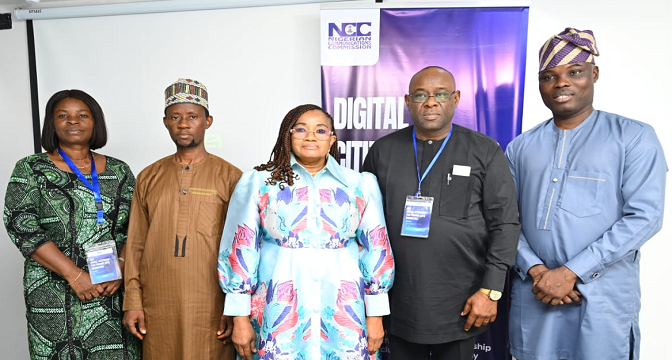
*The Nigerian Communications Commission discloses the two-day Digital Citizenship Training for Persons with Disabilities, held in Lagos, exposed participants to digital foundations, Internet and digital communication, cybersecurity basics, data protection, assistive technologies and responsible participation in the digital space
Gbenga Kayode | ConsumerConnect
In furtherance of its efforts at ensuring that disability does not exclude consumers from opportunities in the burgeoning digital economy, the Nigerian Communications Commission (NCC) has trained over 100 Persons with Disabilities (PWDs) in Lagos State.
ConsumerConnect reports the NCC said the special training programme focused on digital citizenship, cybersecurity, data protection and assistive technologies for the PWDs.
The participants received the training during the recent two-day Digital Citizenship Training for Persons with Disabilities held September 9-10, 2026, at the Cordis Hotel, Ikeja, Lagos.
The theme of the Digital Citizenship Training was “Empowering Persons with Disabilities Through Digital Citizenship for an Inclusive Digital Economy”.
Key objectives of digital citizenship training
Highlighting the core objectives of the training initiative, the Commission affirmed programme exposed participants to digital foundations, Internet and digital communication, cybersecurity basics, data protection, assistive technologies and responsible participation in the digital space.
The telecoms sector regulator also said for several participants, however, the training went beyond learning how to operate digital tools.
The NCC emphasised that the training changed how the PWDs understood their safety, independence and place in an increasingly digital society like ours.
Participants spoke about learning to protect their personal data, identify giveaway, and other online scams, and avoid disclosing sensitive information to unknown persons online.
The Commission noted that others discovered accessibility features, including speech-to-text tools, that could make everyday use of their mobile devices easier and more independent.
Besides, the digital citizenship training programme addressed the social realities faced by Persons with Disabilities.
These include discrimination, helping participants understand that some negative attitudes towards disability stem from ignorance, and should not define their confidence, abilities or participation in society, said the industry regulator.
Dimensions of digital citizenship, by Maida, NCC Chief
Speaking on the strategic importance of such specialised digital training,
Dr. Aminu Maida, Executive Vice-Chairman and Chief Executive Officer (EVC/CEO) of NCC, said the initiative reflected the Commission’s commitment to creating a digital Nigeria in which Persons with Disabilities have the skills and confidence to participate fully in the digital economy.
Maida, represented at the forum by Helen Obi, Director of Digital Economy Department of the Commission, said digital inclusion must go beyond providing Internet connectivity.
Nnenna Ukoha, Director of Public Affairs at NCC, in a statement after the event, noted Dr. Maida said: “Digital citizenship goes beyond operating a smartphone or computer.
“It encompasses the knowledge, skills and responsible behaviours required to participate safely and meaningfully online, protect personal information, recognise scams and misinformation, safeguard one’s digital identity, and understand digital rights and responsibilities.”
The EVC/CEO of the Commission explained that technology could be particularly transformative for Persons with Disabilities by removing barriers to education and employment, supporting entrepreneurship and remote work, improving access to information and public services, and promoting greater independence through assistive technologies.
The Commission’s objective, he stated, is ultimately to build a Nigeria where disability does not determine whether an individual can obtain an education, access public services, secure employment, start a business or contribute productively to society.
Maida asserted: “You are not merely beneficiaries; you are important participants and contributors to Nigeria’s digital economy.
“Your talents, ideas, businesses and aspirations have value, and technology can help take them further.”
According to the Nigerian telecoms regulator, the Lagos programme forms part of a broader NCC initiative to provide digital skills training for Persons with Disabilities across the country’s geopolitical zones.
On key interventions to expand digital access, inclusion
Maida said the initiative built on the Commission’s existing interventions to expand digital access and inclusion, including its E-Accessibility Project, which provides ICT tools and assistive technologies to institutions supporting Persons with Disabilities.
The Executive Vice-Chairman of NCC further highlighted the Commission’s support for research into assistive technology, including an assistive walking-stick prototype for blind and visually impaired persons.
Another, he said, was the fourth NCC Hackathon, with the theme: “Technology Without Barriers”.
It is noted that the edition encouraged innovators to develop solutions promoting accessibility and inclusion in the Nigeria Digital Economy.
For the Commission, these interventions are guided by a simple principle: digital technology should create opportunities, not new barriers.
Maida said connectivity alone would not deliver meaningful inclusion unless Nigerians also possessed the knowledge and confidence to use technology safely, responsibly and productively.
He also stated: “The NCC remains committed to promoting connectivity, digital skills, accessibility, online safety and meaningful participation, with the goal of building a digital Nigeria where Persons with Disabilities can learn, work, do business, communicate and access services with dignity and confidence.”
Maida advocated stronger collaboration among government institutions, regulators, technology companies, service providers, development partners, civil society and Organisations of Persons with Disabilities to ensure accessibility is incorporated from the outset in the design and deployment of digital products and services.
The EVC/CEO of NCC as well acknowledged the Lagos State Government (LASG), National Commission for Persons with Disabilities, Lagos State Office for Disability Affairs, and other stakeholders supporting the programme.
According to NCC, for the 100 participants trained in Lagos, the intervention translated the often, broad concept of digital inclusion into practical everyday skills:
That is, knowing how to protect their personal information, recognising a potential scam, communicating through assistive technology and navigating the digital world with greater confidence and independence.