


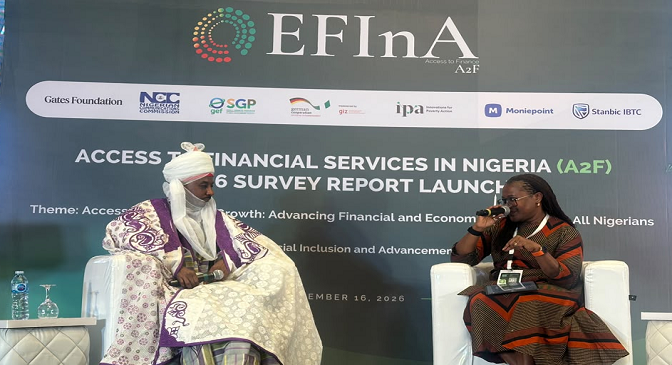
*Emir of Kano, Muhammadu Sanusi II, a former Governor, Central Bank of Nigeria, acknowledges that subsequent developments after his tenure of office have indicated the strategic importance of telecommunications and technology companies in extending financial services to underserved consumers across the country
Isola Moses | ConsumerConnect
Emir of Kano, His Royal Highness Khalifa Muhammadu Sanusi II, a former Governor of the Central Bank of Nigeria’s (CBN), has acknowledged that delaying telecoms companies from offering financial services during his tenure was a mistake.
Emir Sanusi said the decision really set back the West African country’s financial inclusion.
EFCC warns PoS operators against aiding fraudsters, money laundering and terror financing
The erstwhile CBN Governor noted this Wednesday, September 16, 2026, during a fireside chat at the official launch of the Access to Financial Services in Nigeria 2026 Survey Report presented in Abuja, FCT.
Prof. Olayinka David-West Dean of Lagos Business School, moderated the discussion.
Sanusi explained that his opposition to the move at the time resulted from concerns about the safety of depositors’ funds following the banking crisis.
Significance of telecoms, FinTechs in extending financial services
The monarch, however, acknowledged that subsequent developments showed the importance of telecommunications and technology companies in extending financial services to underserved Nigerians.
Recalling the official decisions taken during his tenure as the CBN Governor between 2009 and 2014, Emir Sanusi reportedly said: “I’m responsible for delaying the entry of Telcos into this space.”
According to him, the decision came shortly after Nigeria had emerged from a banking crisis, when banking regulators were particularly concerned about protecting depositors’ funds.
On the rationale for delaying Telcos’ participation in expanding financial services to Nigerians, he further explained: “Part of the challenge, of course, was that we had just come out of a banking crisis where we were worried about depositors’ funds.
“And I wasn’t comfortable allowing companies that I was not a primary regulator of to have access to a huge pool of funds.”
‘Policy decision well-intentioned but wrong,‘ says Emir of Kano
Despite affirming the official policy decision of the Bankers’ Bank at the time, Sanusi, however, acknowledged that the concern, though well-intentioned, resulted in a policy decision he now considers wrong.
He admitted: “So again, this is one case where you have a good intention, but you take a wrong decision.”
Besides, the erstwhile Governor of CBN said he strongly resisted calls from institutions and other stakeholders in the financial system to open the financial services space more quickly to telecommunications companies in the Nigerian economy under his leadership.
He declared: “I fought the World Bank. I fought everybody.”
According to him, allowing Telcos into the sector earlier could have accelerated Nigeria’s progress in bringing millions of unbanked consumers of financial services into the formal financial system.
He stated: “I do think if I had allowed that to happen, it would have been much more progress.”
Expanding tech-driven financial services to Nigerians
The expansion of technology-driven financial services in recent years, Emir Sanusi noted, has demonstrated the limitations of relying largely on traditional banks to deepen financial inclusion.
He also said: “I think we made more progress in the last few years than we did in the first one, because the banks simply don’t have the boots on the ground.
“They don’t have the footprint.”
What 2026 Access to Financial Services report means?
It is noted Emir Sanusi’s remarks came as the 2026 Access to Financial Services survey indicated further improvement in Nigeria’s financial inclusion indicators.
The report of the survey, however, showed substantial gaps yet remain across income groups, gender and geographical locations in the country’s economy.
The survey also indicated that overall financial inclusion increased to 79 percent in 2026, while the financially excluded population fell to 21 percent. Formal financial inclusion rose to 73 percent from 64 percent recorded in 2023.
Meanwhile, reflecting on the marked progress recorded in the financial services sector in recent times, Sanusi affirmed that financial inclusion is one of the policy initiatives that have maintained momentum despite changes in leadership and economic policy in Nigeria.
In regard to the real benefits of financial inclusion to citizens, Sanusi yet cautioned stakeholders that expanding access to bank accounts and digital payment platforms should not be confused with improvements in incomes or economic welfare in the country.
He explained: “Opening an account, moving money, is not the same as earning money.
“It’s not the same as talking about poverty.”
The traditional ruler averred that financial services must be connected more closely to productive activities in the real economy, including agriculture, manufacturing and trade for the ultimate benefit of consumers.
He further acknowledged that the rise of FinTech companies, and other digital financial service providers offers an opportunity to connect financial flows with the movement of goods and services from farmers to markets and manufacturers.
Sanusi also urged the existing digital payments infrastructure to be used to expand access to savings, pensions and insurance in the economy.
Reminiscing, the former CBN Governor said that if he were leading the banking regulator today, he would bring major digital financial service providers together, and challenge them to build pension and savings products around the vast transaction data and networks they already possess.
According to him, small amounts could be accumulated from transactions over time to help informal-sector workers build savings, insurance and pension buffers rather than requiring large periodic contributions.
Emir Sanusi, therefore, urged the leadership of the CBN to remain focused on price stability, describing inflation as one of the biggest threats to household savings and wealth.
He noted: “There is no enemy to savings, no enemy to wealth (creation) that is bigger than inflation.”
The must resist pressure to abandon tight monetary policy prematurely because sustainable savings and household financial resilience depend partly on bringing inflation under control, Sanusi added.
On consumer protection in financial ecosystem
Highlighting the need to protect consumers of financial products and services in the space, Sanusi said consumer complaints involving banks and other regulated financial institutions required clearly defined lines of responsibility among the CBN, the Federal Competition and Consumer Protection Commission (FCCPC) and other sector regulators.
He asserted: “Consumer protection is so critical to financial inclusion that once you begin to fragment and there isn’t one point of call, there is an issue.”