


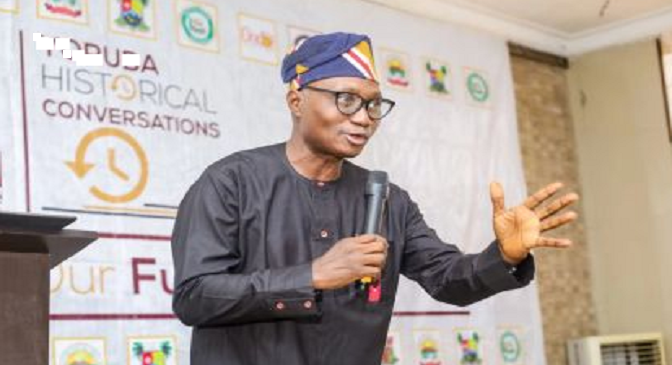
*Adetunji Ojo Ogunyemi, an economic historian, lawyer, public affairs analyst and Professor at Obafemi Awolowo University, Ile-Ife, Nigeria, warns against restoring petrol subsidy, stating besides Federal Government’s inability to support its ‘minimum expenditures’, about 15 States in Northern Nigeria ‘will collapse within three months’
Isola Moses | ConsumerConnect
Arguments and counter arguments over the propriety, or otherwise of returning the West African country to the controversial fuel subsidy regime have continued to dominate public discourse in recent times.
Speaking on the burning issue, Adetunji Ojo Ogunyemi, an economic historian, lawyer, public affairs analyst and Professor at Obafemi Awolowo University (OAU), Ile-Ife, Nigeria, has warned that restoring petrol subsidy could leave about 15 States in Northern Nigeria unable to sustain their operations within three months.
INEC, JAMB collaborate on biometric verification tech, strengthen partnership
Prof. Ogunyemi gave the warning during an interview on Open Forum 360 aired Friday, September 4, 2026, via a podcast hosted by Dare Adekanmbi, and monitored in Lagos.
The don said this in a direct reaction to a recent proposal by former Vice-President (Alhaji) Atiku Abubakar and Presidential Candidate of the African Democratic Congress, to restore petrol subsidy, if elected President come January 2027.
The professor, however, reportedly, argued that returning the oil subsidy would reduce the funds available for distribution through the Federation Account.
President Bola Ahmed Tinubu, GCFR, in his inaugural address, May 29, 2023, had declared that “fuel subsidy is gone.”
The policy decision, shortly after, triggered a sharp increase in petrol prices, and contributed to higher transportation, other services, and living costs for consumers.
Returning oil subsidy regime ‘is calamitous’ for economy
The professor affirmed that most States in the Nigerian Federation currently, rely on savings from subsidy to finance government operations.
Ogunyemi averred: “I think it is calamitous, to say the least, if we reverse the subsidy regime in Nigeria in favour of returning the subsidies.”
The consequences, he stated, would extend beyond the states, listing reduced Federation Account revenue as one of four major problems that would arise from a return to the subsidy regime.
The OAUniversity don further said: “The Federation Account is the jugular of more than 30 states in the Federation. ” “Only about four states in Nigeria can survive without the Federation Account.”
Ogunyemi listed these to include Lagos, Delta and Rivers as states that could cope without depending heavily on Federal allocations.
He, however, cited Taraba as an example of a state whose finances are significantly dependent on the Federation Account till this day.
The University don explained: “So, if you now say reduce the accrual from the account, I tell you more than about 15 states in the North will collapse.
“They will collapse within three months.”
According to him, a revenue squeeze from the Federation Account will make it difficult for several state governments to meet their obligations to workers and pensioners.
Ogunyemi noted: “The second is that states will return to a regime of incapacity to pay salaries, let alone pensions.”
He equally cautioned that the Federal Government of Nigeria would face difficulties funding its recurrent and capital expenditure, if its revenue share declines.
The professor further explained that between 60 and 70 percent of the Federal Government’s expenditure goes to recurrent spending.
He described the development as “consumption expenditure”.
He again, explained: “That is consumption expenditure.
“You reduce the revenue in that respect, you will see a situation in which government will not be able to support its minimum expenditure, let alone go for capital expenditure.”
Besides, he warned that declining revenues could affect Nigeria’s ability to service its debts.
Ogunyemi opined that failure to meet those obligations could damage the country’s financial standing and creditworthiness in the international system.
Atiku’s proposal, a ploy to gain political support, says Ogunyemi
Aside from far-reaching consequences of retiring the fuel subsidy regime, Prof. Ogunyemi also questioned Atiku’s proposal, hinting that the former Nigerian Vice-President and Presidential Candidate in the 2027 Election could be using the subsidy promise to gain political support from Nigerians.
He, nonetheless, contended that as having served as the Vice-President, Alhaji Atiku should be more explicit about the possible consequences of restoring the subsidy in the economy.
It is recalled that Atiku had initially pledged to restore the subsidy, arguing that Nigerian consumers had not seen sufficient benefits from its removal.
He also queried how the funds saved from the policy had been used thus far.
However, days after the purported pronouncement, Atiku later clarified that his proposal was not a return to the former import-subsidy arrangement.
Atiku rather said he preferred a “targeted and capped intervention” that would support domestic refining and production, with transparency and auditing built into the scheme.
Meanwhile, the Nigerian Government has defended the decision to discontinue the oil subsidy regime since 2023 as necessary to reduce fiscal pressure, and “free resources” for other levels of government, including state and local councils.
The Federal Ministry of Finance recently, also disclosed the current administration’s economic reforms has generated estimated N15.8trillion in resources for the entire Federation between June 2023 and December 2025.