


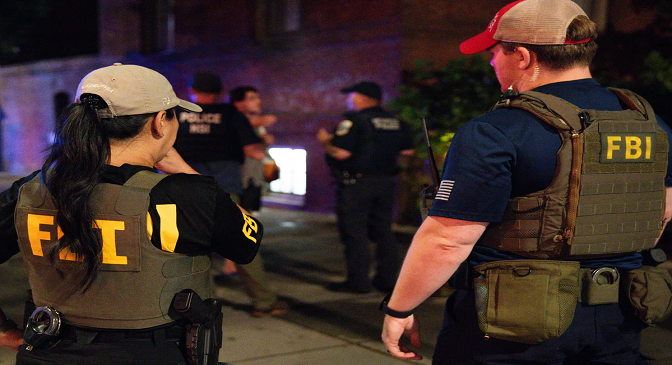
*The United States Federal Bureau of Investigation asks a Federal court in Washington, D.C., for permission to ‘privately explain’, stating the information withheld under the American country’s exemptions could reveal law-enforcement investigative techniques and procedures, or ‘could reasonably be expected to endanger the life or physical safety of any individual’
Isola Moses | ConsumerConnect
Amid the petitions for express disclosure of records of his alleged involvement in narcotics trafficking decades ago, the United States (US) Federal Bureau of Investigation (FBI) has asked a Federal court in Washington, D.C., for permission to “privately explain” why it has withheld portions of records in connection with longstanding investigations involving President Bola Ahmed Tinubu.
The FBI request was contained in an application dated August 20, 2026, filed before the United States District Court for the District of Columbia in an ongoing Freedom of Information Act (FOIA) lawsuit brought by Aaron Greenspan, Founder of the legal transparency Web site.
ConsumerConnect learnt the FBI is seeking leave to submit an ex parte, in-camera and under-seal declaration to the judge. Such a filing would allow the agency to explain confidentially, outside the public record, the full basis for withholding some of the information, agency report said.
FOIA exemptions and reasons for non-disclosure of records
The FBI declared that it could not publicly disclose all the reasons behind its reliance on certain FOIA exemptions because doing so could itself reveal sensitive law-enforcement information.
The secret police agency specifically, cited FOIA Exemptions 6, 7(C), 7(D), 7(E) and 7(F) in dealing with the records requested by Greenspan, report stated.
Besides, the FBI said information withheld under the exemptions could, among other things, reveal law-enforcement investigative techniques and procedures or “could reasonably be expected to endanger the life or physical safety of any individual.”
The agency said it could not provide on the public record the full basis for its reliance on Exemptions 7(E) and 7(F) for certain withheld material.
It, therefore, asked the court for permission to make a confidential submission explaining the reasons to the judge.
Commenting on repeated requests for disclosure of Tinubu’s alleged drug trafficking records, the FBI however, said it would provide the additional explanation before August 28, 2026, stating “if the court grants the permission.”
The application identifies two FBI FOIA requests.
The first, Request No. 1588244-000, sought the entire FBI file for Bola Ahmed Tinubu, identified in the request as Nigeria’s President-elect at the time the request was made 2023.
According to the agency, the second, Request No. 1593615-000, sought FBI Form 302 interview records involving Tinubu from FBI Case No. 245-IP-71386-UUUUUU during the period covering 1992 and 1993.
The records form part of Greenspan’s broader effort at obtaining government documents relating to investigations dating to the early 1990s.
The latest FBI application does not, however, say that disclosure of every record concerning Tinubu would endanger lives. Rather, the investigative agency says disclosure of information covered by particular exemptions could reasonably be expected to endanger the life or physical safety of an individual, according to report.
That distinction is significant because the FBI’s confidential explanation has not yet been presented publicly.
It is also noted that the latest filing is the newest development in a years-long legal battle over access to records held by the United States Government agencies.
Greenspan filed multiple FOIA requests seeking records relating to investigations from the early 1990s.
The requests have involved several US agencies, including the FBI and Drug Enforcement Administration (DEA).
The U.S. District Court for the District of Columbia, April 2025, ordered the FBI and DEA to search for and produce non-exempt, reasonably segregable portions of records responsive to Greenspan’s requests.
The agencies subsequently sought additional time to complete their searches and production.
Meanwhile, the litigation reportedly has attracted considerable attention in Nigeria because some of the requested records concern Tinubu, and events dating to his years as a resident in the United States.
Does an investigative material or document by itself establish criminal guilt?
The existence of records, an FBI investigation, or allegations contained in investigative material does not by itself establish criminal guilt, report stated.
More so, there is also no indication in the latest FBI application that Tinubu has been convicted of drug trafficking, based on the records at issue while in the US.
It was gathered that latest application to access the records is principally a dispute over FOIA disclosure and the US Government’s right to withhold certain information, rather than a criminal proceeding against the Nigerian President.
Still, the FBI is asking the court to allow it to explain privately why particular information should remain withheld in its custody.
The court will determine whether to permit the confidential filing, and ultimately, whether the agency’s withholding of the disputed information complies with the Freedom of Information Act in the United States.
Request for records and political interests ahead Nigeria’s 2027 Elections
Reports indicate that the development has come up again, in regard to long-running controversy over US records relating to Tinubu’s past.
This has continued to attract political interest in the West African country ahead of the 2027 Presidential Election slated for January next year.
The latest application for the records, however, “should not be interpreted as a new criminal charge, indictment, or finding of guilt against Tinubu,” report noted.
Tinubu seeks 10-day pause in release of records
It is recalled that President Tinubu recently joined the US Department of Justice (DOJ) in seeking a 10-day extension to respond to a motion seeking the release of records relating to allegations of drug trafficking in the American country.
ConsumerConnect reports President Tinubu’s legal team had filed a notice of joinder before the US District Court for the District of Columbia, asking to be placed on the same schedule as the defendants in the case.
The filing was published online by Von Batten-Montague-York, L.C., a US-based policy advisory and lobbying firm retained by former Vice-President Atiku Abubakar.
In the notice, Tinubu’s lawyers said they were joining the defendants’ request for a 10-day extension to respond to the motion for summary judgment.
The legal team stated in the filing: “Intervenor joins Defendants’ motion for a 10-day extension of time to file response to the motion for summary judgment (DE 92), inasmuch as Intervenor requests that the responses remain on the same schedule.”
Christopher W. Carmichael and Victor P. Henderson of Henderson Parks, LLC, signed the notice, according to report.
According to the filing, the plaintiff opposed the request, while the defendant did not.
However, US District Judge Beryl Howell subsequently, denied the application for an extension, according to the lobbying firm.
Von Batten-Montague-York, in a in a post on X (formerly Twitter), alleged that the requested delay could give Tinubu additional time to lobby US officials against the release of the records.
The firm also claimed that the records could become a subject of discussions around US-Nigeria relations and Tinubu’s cooperation with Washington on security matters.
It also raised concerns about what it described as possible attempts by US Government officials to influence the judicial or Freedom of Information Act process.
It is equally stated that the case, Aaron Greenspan v. Executive Office for U.S. Attorneys, et al., Civil Action No. 23-1816 (BAH), has been pending for over three years.
Previous reports have linked a $460,000 asset forfeiture involving Tinubu to a US federal investigation into a Chicago-based heroin-trafficking network in the late 1980s and early 1990s.
Court records and affidavits from US authorities have been cited in reports about the forfeiture proceedings.
In 1993, a US District Court ordered the forfeiture of $460,000 held in an account in Tinubu’s name to the US government.
The order stated that the funds represented proceeds of narcotics trafficking or were involved in transactions violating money-laundering laws.
However, Tinubu consistently, denied wrongdoing, and rejected allegations that he was actually involved in drug trafficking into the US.
Similarly, Tinubu’s lawyers have maintained that the forfeiture proceeding was an in rem civil action against the money, rather than a criminal case against Tinubu as a person.
The legal team further contended that he was never arrested, indicted, arraigned, or convicted of a drug offence in the United States at any time while resident in the country.