


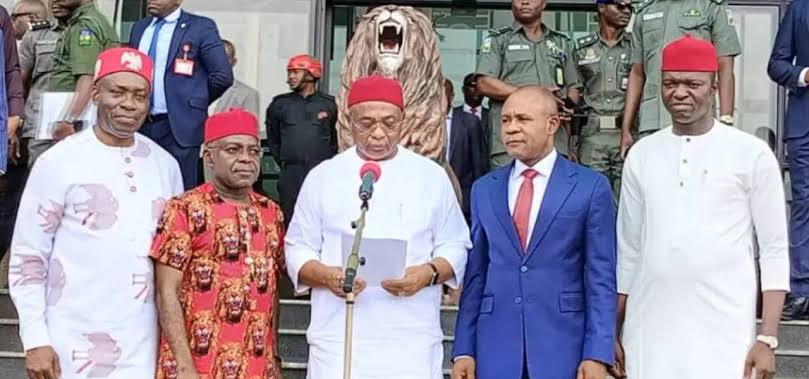
*Governor (Senator) Hope Uzodimma of Imo State disclose the resolve of the South-East State Governors to fully support the re-election of President Bola Ahmed Tinubu
Alexander Davis | ConsumerConnect
In appreciation of his developmental initiatives across the five South-East states, in Nigeria, the governors have resolved to fully support the re-election of President Bola Ahmed Tinubu, GCFR.
ConsumerConnect gathered though the State Governors belong to three separate political parties, their resolve is based on the fact that no President since 1999 has addressed the welfare of Ndigbo more than Tinubu.
DEON: Telecoms operators appeal against FCCPC’s regulatory powers on consumer lending regulations
Governor (Senator) Hope Uzodimma of Imo State disclosed the resolve of the State Governors, in Owerri, the state capital, at a meeting with traditional rulers and members of the State Elders’ Council.
The Imo Governor said contrary to the grandstanding of some enemies of Ndigbo, the people are fully aware that President Tinubu serves their best interests, and therefore, would repay his magnanimity during the 2027 Presidential Election.
Uzodimma, who doubles as the Chairman of the South-East Governors Forum and the Progressive Governors Forum, however, cautioned politicians against the use of Igbo platforms to canvass propaganda that has no factual basis.
The Imo Governor asserted: “The Igbos are too discerning and too results-driven to trade tangible infrastructure for political speeches.
“The South-East will stand with the Tinubu administration that has favoured them.”
He equally said the state governors in the South-East had reviewed the performance of the Tinubu administration, as it affects the development of the region.
According to him, the fellow governors unanimously, agreed that the region would continue to identify with the President and the Renewed Hope Agenda because of the tangible dividends already delivered.
The South-East could no longer be swayed by political rhetoric when the evidence of Federal intervention across the zone was visible, stated he.
The governor of Imo State noted: “We, the five governors of the South-East, have reviewed all options, and decided that we will work with President Bola Tinubu because we want to be part of Project Nigeria.”
Uzodimma said the governors would soon pay a joint courtesy visit to President Tinubu to further strengthen their partnership with the Federal Government.
Giving insight into the resolve of the South-East state governors, he disclosed their decision was informed by the current administration’s record of addressing long-standing developmental concerns in the South-East, including the establishment of the South-East Development Commission (SEDC), a demand that had remained unmet since the end of the civil war.
Uzodimma as well stated that President Tinubu signed the South-East Development Commission Act into law July 24, 2024, inaugurated its governing board, February 2025, and ensured that the Commission commenced operations with funding.
He also highlighted the rehabilitation and commencement of commercial operations on the Port Harcourt-Aba rail line.
The governor described this transportation infrastructure as the first practical step towards reconnecting the South-East to the national rail network.
Uzodimma further applauded Tinubu’s approval of a $3 billion reconstruction of the Eastern Rail Corridor, stretching from Port Harcourt through the South-East to Maiduguri.
The project, he noted, would significantly boost commerce and regional integration.
On road infrastructure, the governor commended the Federal Government for executing the Phase 2A and 2B access roads to the Second Niger Bridge, including the dual carriageway linking Umunya, Ogbunike, Ogidi, Nkpor and Asaba, with seven bridges along the corridor.
Uzodimma as well mentioned the approval of the 108-kilometre Otuocha-Anam-Abaji Road and the 150-kilometre Oba-Nnewi-Uga-Ihube/Okigwe Junction Road.
He said the projects would strengthen economic connectivity between Anambra, Imo, Abia and other parts of the West African country.
Uzodimma also argued that beyond projects specific to the South-East, the region had equally benefited from national policies of the Tinubu administration.
These, he stated, include increased allocations to states, student loan programmes, improved security efforts, and fiscal reforms aimed at reducing the cost of doing business.
The governor said: “The South-East has decided. Our people judge governments by performance, and not by political sentiments. The evidence is on the ground.”
On Charter of Equity, and governance of Imo State
Highlighting the state matters and governance, Governor Uzodimma urged the Imo State Elders Council and traditional rulers to remain committed to the implementation of the state’s Charter of Equity, insisting that the law remained the foundation for lasting peace, justice and political stability in Imo State.
The governor recalled that upon assuming office in 2020, he inherited a deeply divided state and initiated reforms aimed at restoring order, rebuilding trust, and ensuring inclusiveness in governance.
The enactment of the Charter of Equity by the Imo State House of Assembly was designed to institutionalise fairness in the rotation of political power, and guarantee that every part of the state had a sense of belonging.
Said he: “The Charter of Equity is real, and I need your mandate to implement it because that is what will bring lasting peace to Imo State.”
According to him, the next governor of Imo State must emerge in line with the Charter of Equity and possess the character, integrity and commitment required to preserve the gains recorded by his administration.
He stressed that whoever succeeds him must be God-fearing, fair-minded, and committed to sustaining the principles of equity, justice and good governance rather than reversing the progress already achieved.
Uzodimma warned against attempts to undermine the Charter of Equity for personal political interests.
He also stated that he would personally defend the law to safeguard the future stability of the state.
The governor declared: “I will take the fight personally to protect the Charter of Equity. I will stop at nothing.”
Skills acquisition and vocational education
Governor Uzodimma advocated greater investment in skills acquisition and vocational education.
He noted that equipping young people with practical skills remained one of the most effective ways of tackling unemployment, reducing crime and driving sustainable economic growth in Imo State.
The Imo Governor as well urged traditional rulers to continue supporting government initiatives aimed at maintaining peace, promoting development and ensuring that the state remained on the path of stability and inclusive progress.