


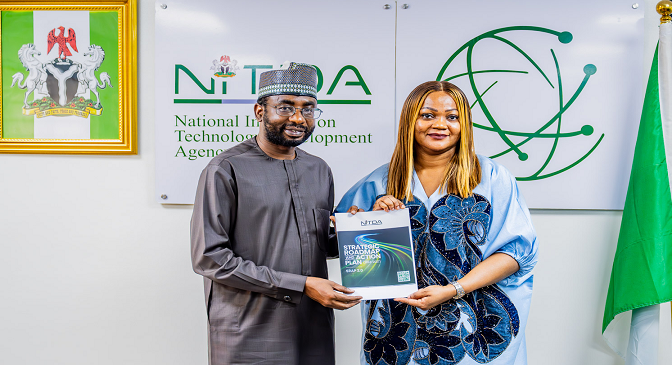
*Kashifu Inuwa Abdullahi, CCIE, Director-General, Nigeria’s National Information Technology Development Agency, describes the formal transfer of assets, technology, and operations to the National Identity Management Commission as a clear demonstration of the agency’s commitment to collaborating with institutions leveraging technology for national development
Isola Moses | ConsumerConnect
The National Information Technology Development Agency (NITDA) has officially handed over its Public Key Infrastructure (PKI) framework to the National Identity Management Commission (NIMC) in a strategic move towards Nigeria’s technological advancement.
ConsumerConnect reports NITDA said the transfer of assets, technology, and ongoing operations was designed to provide the robust security backbone needed to establish a modern, integrated, and highly secure national digital identity ecosystem.
The agency’s formal handing over of the documents occurred during the courtesy visit of the NIMC leadership to thr NITDA headquarters, in Abuja, FCT.
Speaking at the ceremony, Malam Kashifu Inuwa Abdullahi, CCIE, Director-General of NITDA, described the development as a clear demonstration of the agency’s commitment to collaborating with institutions leveraging technology for national development.
It is noted that the handover directly supports the updated NIMC Act 2026, which President Bola Ahmed Tinubu recently signed into law, in Abuja, FCT.
The NIMC Act aims to harmonise identity databases across government agencies, and establish the National Identification Number (NIN) as the cornerstone for identity verification, authentication, and public service delivery in the economy.
The Information Technology sector regulatory agency disclosed Inuwa noted that NITDA has done extensive, foundational work around PKI and Digital Public Infrastructure (DPI).
The Director-General of the agency also said NITDA would work hand-in-hand with NIMC’s team to ensure a seamless transition of the infrastructure.
How about PKI technical framework?
NITDA explained that as a technical framework, PKI enables the creation, management, verification, and authentication of digital identities using digital certificates.
The agency noted the framework also serves as a vital tool for ensuring secure, trusted, and encrypted communications and transactions across the country.
During the engagement, Inuwa also reaffirmed NITDA’s broader commitment to driving nationwide technology adoption.
He further emphasised that as Nigeria’s apex IT regulator, NITDA’s core mission is to help every citizen adopt and utilise technology.
The Chief Executive of NITDA, therefore, pledged continued support for NIMC, and any other institution working to digitise their operations.
Inuwa as well explained that NITDA’s mandate extends beyond regulation to fostering collaboration, supporting innovation, and ensuring digital solutions are inclusive for all.
He further stressed that Digital Public Infrastructure is just as vital to economic growth as physical infrastructure, and must remain secure, reliable, and accessible.
Responding, Engr. (Dr.) Abisoye Coker-Odusote, Director-General and CEO of NIMC, commended the NITDA leadership.
Coker-Odusote highlighted the transformative potential of the newly enacted NIMC Act 2026, which officially replaces a nearly two-decade-old framework from 2007. She also explained that the new law marks a structured, coded transition from a traditional identity database to a modern digital identity ecosystem.
According to her, this shift is designed to ensure seamless interoperability, security, and efficiency across both public and private sector platforms.
It is equally noted that by moving away from old card-based systems toward secure digital credentials, the new framework is anchored on the principle of “one person, one identity,” giving every Nigerian a unique and verifiable digital presence.
The agency stated that the updated Act provides the essential legal backing for deploying PKI, and other trust frameworks to secure these digital interactions.
To safeguard citizen data and maintain public trust, NIMC is rolling out this transition in carefully planned, gradual phases, noted NITDA.
Both agencies emphasised that close cooperation is key to realising Nigeria’s digital transformation goals.
In regard to the two organisations’ collaboration, NIMC manages the foundational identity backbone whereas NITDA will continue to focus on ecosystem development, regulation, and driving widespread tech adoption.
This alignment represents a unified step forward in building a secure, inclusive, and innovation-driven digital economy where all Nigerians can thrive.